|
|
History of tile (glazed brick), manufacture and decoration in Iran, goes back to the prehistoric period. It has an important position among the various decorative arts in Iranian architecture. Four main decorative features could be categorized here. They are stone carvings, brick work, stucco and tile panels. The intricate method of manufacture, designs and type of materials used in these four methods have evolved as a result of natural factors, economical and political effects.
Tiles were used to decorate monuments from early ages in Iran. Mosaic patterns were the first step in the evolution of tile decoration. Imaginative and creative artisans put together mosaic patterns using bits of colored stone and brick and created patterns of triangles, semi-circles and circles in harmony with the structures they were placed on. These patterns later evolved into design of natural subjects, such as plants, trees, animals and human beings. The earliest examples of mosaic patterns have come from the columns of the temple at Ubaid in Mesopotamia, and are attributed to the second half of the 2nd mill. B.C. Here, colored pieces of stone have been juxtaposed with shell and ivory to create geometric patterns. It is these early mosaic patterns which are the roots of later tile art. The first glazed bricks, a further advancement in tile art, have also been discovered in such sites as the palaces of Ashur and Babylon in the same area. A most famous example of early tile art on wares is the mosaic rhyton discovered in the excavations at Marlik. This vessel has two shells. The outer shell is covered with colored pieces of stone. This object is known as “Thousand Flowers”. One of the earliest examples of Iranian tile work on architecture, actually glazed pieces of unbaked brick, have been excavated at Susa and Chogha Zanbil, and are attributed to the end of the second millennium B.C.
In the Achamenian period full use was made of glazed and decorated fired bricks in yellow, green and brown on the palaces of Susa and Persepolis. Fired and glazed bricks were an Important advancement in tile technique. The “Eternal Soldiers” at Persepolis have long elegant gowns in glaze made of fired earth and plaster.
Glaze was used on vessels and even coffins in the Parthian period, but little architectural evidence has been discovered to show that glazed bricks were used. Turquoise and light green glaze were the most popular colors. Fresco painting was more popular for the decoration of buildings.
Excavations in Firuzabad and Bishapur have yielded much evidence of tile art and mosaic manufacture for the Sasanid period. Here, tiles have glaze that is one centimeter thick, and mosaic patterns of flowers, plants, geometric designs birds and human beings.
The art of tile working blossomed in the Islamic period of Iran. It became the most important decorative feature of religious buildings.
Iranian tile makers were in great demand and worked in the far corners of the Islamic empire. The earliest example of Islamic tile decoration can be seen on the Mosque of the Dome of Rock belonging to 7-8th century A.D.
Before tile work, as we know today, became popular brick and stucco were most important in decoration of buildings up to 10-11th A.D. Two mosques of Na'in and Neiriz have brick decoration in geometric patterns of the Buyid period. By 11-12th A.D. , brick decoration had spread from the east throughout Iran. The best examples of brick decoration of this period are the mausoleums of Pir Alamadar, 1026 A.D., Chehel Dokhtaran, 466 A.D., and the Tower of Mihmandost 1096 A.D.
The next stage of development was the use of colored glaze on decorative brick; turquoise being the most popular color. Pieces of turquoise glazed bricks were used with decorative brick works on monuments from the Saljuq period onwards.
So artisans were familiar with the technique of manufacture of glazed bricks by this time. Sometimes these turquoise glazed bricks were used to create Kufic inscription among the brick patterns or were scattered among the brick patterns. The earliest example unfired turquoise Kufic inscription, is a panel stored at Iran Bastan Museum (National Museum of Iran) ascribed to the end of the 10-11th A.D. Other religious structures which have turquoise tile works are Seyed Mosque, Isfahan, 1122 A.D., the red Dome of Maraqeh 1147 A.D. and the Jame Mosque of Gonabad 1212 A.D.
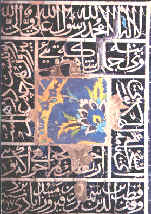
Mongol invasion slowed and halted many artistic traditions and trends. Normal conditions only returned by the 13th century A.D., when the Ilkhanid rulers accepted Islam; they also became interested in creating secular and non-secular monuments and buildings. By this time, decorative bricks and tiles were used not only on the exterior, but also inside the building to cover the walls and domes.
The art of tile manufacture reached its highest point of perfection and beauty at the end of Ilkhanid period and the beginning of Timurid in the form of Moraq tiles (mosaic style). Tile panels created with this technique are very durable and could withstand the elements of time. Here, tiles in such colors as yellow, blue, brown, black, turquoise, green and white were cut and carved into small pieces according to a previously prepared pattern. These pieces were placed close together and liquid plaster poured over to fill in all the opening and gaps. After the plaster dried and hardened, a large single piece tile panel had been created , which was then plastered onto the required wall of the building. Timurid monuments in Herat, Samarkend and Bukhara were covered by this decorative technique. Among the most famous monuments so decorated are Goharshad Mosque (1418 AD.), Molana Mosque (1444 AD.), Jame Mosque of Yazd (1456 AD.), Jame Mosque of Varamin (1322 AD.) and Madrassa of Khan in Shiraz (1615 AD.)
From the beginning of Safavid period, another method of tile decoration was added to the repertoire of artisans. Economical and political reasons prompted the creation of this "Seven Colors" (Haft Rang) tile to decorate many religious and non-secular buildings, which were made in great numbers in this period. Reasons which caused the popularity of this technique were:
1- "Seven Colors" tiles were cheaper to produce.
2- Less time was needed for their manufacture.
3- Artisans could extend their repertoire of motives and designs for decoration.
Square tiles were placed together and necessary design was painted in glazed colors on them. Each tile was fired. Then all were placed again next to each other to create the main large pattern. Arabesque motives were extremely popular. This method of tile decoration was popular until the end of Qajar period, when the repertoire of colors extended to include yellow and bright orange.
Another important type of tile decoration at this time was luster tile. It was in demand by the end of Saljuq period and reached to its highest point of perfection in Kharazmshah and Ilkhanid eras.
Luster tile panels were made in square, rectangle, hexagon, octagon and polygonal forms. They contained luster designs of human, animals, floral and geometrical motives with borders of inscriptions, which included poems, proverbs and sayings attributed to Prophet and other religious personalities. Many of those tiles were discovered in the excavation at "Takht Soleiman", especially from the palace of Abagh Khan (Ilkhanid period) and in Gorgan, Kashan and Khorasan regions.
Exquisite luster mihrabs appeared in 13th AD. Workshops of such cities as Gorgan, Soltanieh, Saveh and Kashan specialized in creation of these pieces. Shiraz, Kerman and Meshed became important luster tile producing centers during 17th AD. centuries. In Meshed, Mosque of Imam Reza (1215 AD.) has fine luster decorated tiles.
Another popular technique was brick and tile decoration, a technique which had evolved from earlier decorative combinations of tile and brick; though, polychrome tiles were used instead of monochrome ones. This type of decoration was used in religious and non-religious buildings from 13th AD. onwards. Jame Mosque of Varamin (1322 AD.) , Soltanieh Dome (1304-1311 AD.), Jame Mosque of Ashtarjan (1315 AD.) and Vakil Mosque (1773 AD.) contain fine examples of this type of tile decoration.
Variety of design of this technique included large inscriptions known as “Moqili", seen mostly in religious buildings such as Jame Mosque of Isfahan (14th AD.) and Hakim Mosque of Isfahan (1656 AD.)
Evidence of brick work, stucco carving and tile panels from the last 14 centuries have provided much evidence of creative and imaginative nature of Persian Artisans. They placed their art in the service of religious architecture. This religious inspiration found its highest expression in ornate inscriptions, which decorated so many works during these centuries.
In 8-10th centuries AD., most of these inscriptions included sayings, proverbs, wishes, maxims, names of religious personalities and invocations of Allah's help, in decorative, simple or broken Kufic script and are found on poetry, such as ceramic wares of Neishabour.
In 13-14th centuries AD., ceramic wares and tiles were decorated with many different forms of inscriptions. The most popular were molded decorations and inscriptions with messages of happiness, good health, prayers, wish for victory, proverbs, simple messages of good will, poems and the name of Allah. Workshops at Kashan, Rey and Gorgan produced these types of ware.
Broken Taliq script became popular in 11-14th centuries AD. This script was in luster and under-glaze decoration, contained lines from poems and verses of such poets as Ferdowsi, Hafiz, Molana and Baba Afzali Kashani. Furthermore, it became popular for artisans of Kharazmshah and Ilkhanid periods to add the date of manufacture and the name of maker. The oldest dated tile is of 1203 AD. Tile panels of these period had mostly square, lotus, star and polygonal form and were put together to create panels.
In Safavid era, Naskh and Thulth scripts were used. Works of famous calligraphers, such as Alireza Abbasi, Mohammad Saleh Isfahani, Mohammad Reza Imami and Hossein Banna have been found.
It should be mentioned that the technique of tile and its secrets of trade were safely guarded and orally handed from father to son and master to student; thus rarely have designs, patterns and details of technique been documented and few complete treatises exist on the art of Iranian tile work in the past.
Pictures of some samples of:
- Designs
- Tiles
|
|