|
|
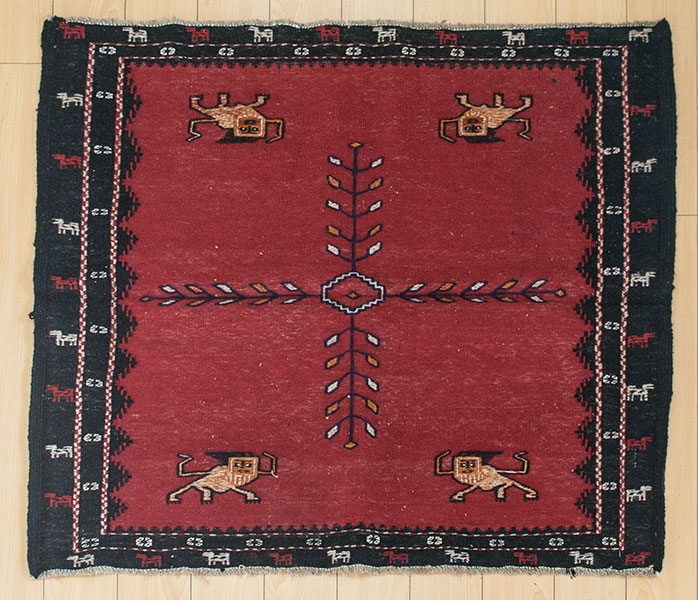
Sofreh of tribes and villagers is woolen and woven as kilim. Its appearance (except for its image) caused it to be called usually "kilim", while kilim and sofreh are different and sometimes antithetic.
Kilim is a kind of carpet, to be used as floor cover, but sofreh is spread only at lunch and eating time, later it is left away, not used for other purpose.
Another kind of sofreh being voguish until recently, was Calico or printed sofreh (Qalamkar). It was produced of cotton and was ornamented with traditional images.
Combination of those sofrehs is almost similar to designs of traditional carpets; i.e. there is design-full margin around it and some medallion or spiral arabesque on ground. Ground, like other tribal sofrehs, is design less, but around margin, some poems are placed in relation with sofreh and food.
Qalamkar, has been in use among rural and medium classes, having a large size. Though there's no sample of kingly sofrehs remained, but no expression of its modality may visualize their forms. Tourists, traveling to Iran in Safavid era, have mentioned about these kingly sofrehs, specially, Ambassador of Spain in Iran at Kingdom of Shah Abbas the great, about 17th century, has beckoned to those kingly sofrehs. To sofrehs, which were spread, while his reception before the King, with very fine fabric, ornamented with golden brocade over silk fabric.
Though tribal sofreh and eating and dining in tribal and villagers houses are plain and without formality, sofreh of Kings and riches have been sumptuous and glorious.
Profession of chief steward was an important task in court of kings. He had the responsibility of spreading sofreh and entertaining guests and preparation of delicate foods. Setting sofreh, also had some formalities, prepared for each sofreh and each service.
Tableware of sofreh has been different than those of dining-table. In European service of dining-table, six or twelve sets of knife, spoon, fork and plates are used, while sofreh cutlery is limited and also relative to the host position.
Sofreh gadgets were set according to the size of sofreh. Preparation of outfits and high class parties have been possible only for a little group of rural riches and tribal “Khans”. Some of the latter persons, in Bakhtiari, Qashqai, Kurd and Shahseven were so truly rich, that could provide all rural facilities in their tents or in their marvelous palaces and some of the long-large tribal sofrehs is a reminding of this truth.
The more we could remind, rich sofreh and their expensive gadgets, sofreh of most people, such as villagers, tribesmen and most rural people, were small, having no ceremonial appliance. They had only one small sofreh, used for both dining cloth and bread. Bread was their only main food. They take the word of food as bread and vice versa. Gadgets in this sofreh is nothing, but one or two earthenware bowl and mug.
Knowing the fact, that villagers and tribesmen eat their lunch, sitting on the floor. They spread sofreh in eating time and another sofreh for preserving bread. It is not known why no hand woven sofreh remained, specially when we consider that Turkmen, Lor of Lorestan, Khamseh of Fars, Qashqai and Kurd of West Iran, … all have skill in weaving.
The most important sofrehs, woven by tribes residing in Iran are:
Shahseven
Kurd
North West Kurd
Lor of Bakhtiari
Qashqai and Khamseh
Afshar of Kerman
Afshar of Khorasan
Baluch
Varamin
|
|