|
|
There is not much knowledge about the world’s first knotted carpets, their periods and weaving places and what exists, is more guess and assumption. In reversed researching of development and progress path of Carpet and Kilim weaving techniques, such a useful craft, we find out that only reason for creation of this craft has been an answer to the need of people of desert, who lived in tents.
In the past, European researchers, based on their relatively reliable evidences, believed that Egyptian and Assyrian civilizations have been the cradle of world’s carpet weaving. There is no doubt, that the quality of first types of carpets have been similar to felt or primitive textile products. But, since there is no sample of first carpets, because of their poor quality, none of assumptions, theories and deductions of historians and researchers have been able to propose an exact period of time for the first precious human woven piece.
There is no doubt, that even Iranians can’t claim to have produced the first hand-made carpets, but the evidences specially finding carpet named “Pazirik” proves the great role of Iranians in creating this valuable art. Iranian Carpet’s history is still a mystery. These mysteries generally exist, also in other Iranian arts and crafts, but not as much as in weaving history. After discoveries of archeologists, especially Rodenko the famous Russian archeologist, who discovered a knotted carpet among the icebergs in the first half of recent century, the whole assumptions changed totally. Location of weaving craft changed from Nile coasts and Dajleh and Forat Rivers to Central Asia.
In 1949, in a place called “Pazirik” (80 km to Mongolia border, among Altai mountains), professor Rodenko discovered a knotted carpet in the frozen graves of people, who lived in tents in desert, that originally was a horse-trapping. This carpet belongs to 2500 years ago and is 2*1.8 Sq. m with 3600 knots in sq. dm, which is woven in copper-brown and light green colors. It’s margin images are doubtlessly very similar to common shapes in Achamenian period and Persepolis’ images. In central ground of this carpet, there are four-winged star shapes, which are exactly the same as ones on discovered objects in Lorestan.
There are different opinions about the historical record of this important carpet, which is kept in Hermitage museum in Leningrad. Professor Rodenko believes, that this carpet has been woven in Medes or old Parthain’s time. Like Rodenko, Dimand also believes that since Assyrian, Achamenian and Sakai images are used in this carpet, therefore it has originated from Iran.
“Ulrich Sehurmann” goes further and believes that this carpet is woven in Azerbaijan. While, ”Ian Bennett” believes, that regarding a distance more than 3500 km from Altai Mountains to boarder lines of present Iran, it is improbable for this carpet to be woven by Iranian weavers.
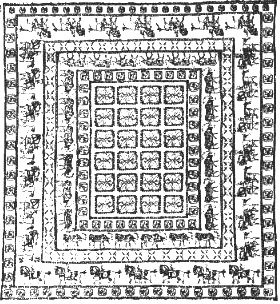
Pazirik
|
|