|
|
Turkmen is a Turkish clan living now in North of Iran, North of Afghanistan and East part of Caspian Sea, in Republics of Turkmenistan and Uzbekistan.
This people, though having preserved their originality, have lost many traditions, whether during the wars with adjacent people, or under influence of governing cultures of neighbors, so that following their history is quite difficult.
They, more than anything, are fond of their carpets, have woven it in various features and different sizes, to supply their various needs of migration and semi-decamping life and cause delight and mirth to migration way of living.
The recent evolutions, have deprived world from their woven handicrafts of tribes such as mirror-case, spoon case and salt container (Namakdan), to the best carpets that family
weave as dowry to offer to its daughter..., of pitchers, saddle covers, bridles, siliques to the various pieces used to closing, covering of curtain or in a tent.
Some woven used as sleeping bed, suitcase or ornament were as a symbol of economic-financial stand and social value of the family and in the same time could remove financial problems of family; today, most of those hand-woven are replaced by modern artificial, in cities.
Woven of tribes, specially Turkmen, were so elaborate and skillful, that created wonderful collection with most simple and primitive tools. Those objects, sometimes, specially on wedding, were exhibited on horses or camels.
In the same time, those carpets, though carefully and elaborately woven, were not durable and soon became threadbare, therefore only some samples of those carpets are remind, which notwithstanding the accidents and happenings are saved, in the course of time.
The oldest sample goes back not further than18th century AD., when the history of Turkmen carpet is not quite clear.
Like every tribe, economic foundation of Turkmen is animal husbandry, but geographic and political situations sometimes produced better possibility for tribe, such as agriculture.
During the time, Turkmen were not so much attached to government, though they were effective, sometimes in formation of governments or their governing forces.
Another source of their income is participation in transport business and securing caravan roads or international highways, spread from West China to Anatolia.
Sometimes governments, rich men or merchants would hire a few hundred or thousand camels, horses or ponies from migrant Turkmen, who secured the hazardous or could attract the grace of governments, even at some instances an unsecured zone was given to this tribe against exemption from tax and duty.
Although carpet weaving, in some of Turkmen tribes, is not confirmed, but some clans, bigger, stronger or older than other clans, used to weave carpet.
General pattern of Turkmen carpet shows no important evolution, but is remained as repetitive images, which have 600 years of precedent in Iran and could be seen in many miniatures of 13th century A.D. and onward.
Whereas the oldest carpet of the world, has also repetitive images, it is a fact that Turkmen images are remained in a primary static state.
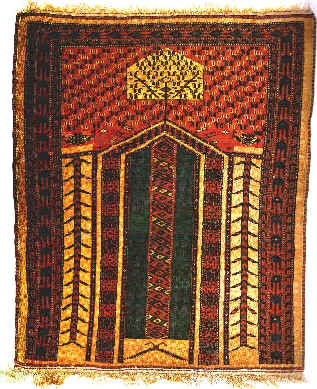
Yamut Tribe: Prayer Rug, 1.18x0.97 m, (18-19th century)
|
|