|
|
Saucer (Plate)
1- It is rug basic image smaller than 15*15 cm., but very similar to Chapat-e-Oshtor.
2- Rug pattern containing three separate Medallions in the shape of Saucer and eight half-medallion (Nimkat). Saucers have two margin, one Jovak and one karchok, and their middle images are “Pouti”. A rectangular Latteh is seen in the space among medallions and at two ends of pattern, each of them contains four Eyebrows. Margins are usually Jovak, wavy, Jovak from outside towards inside. Colors are mostly camel color, navy blue, Madder, Gaz flower and white.
3- Basic image in the shape of straight line, with two ends slightly broken to one side.
|

|
Scroll (white corner (lachak), Shooshaki)
Zigzag shape margin made of while and oblique Latteh shapes.
|

|
Seal
A group of carpet basic image-specially kilim-in various shapes, like lozenge, Butterfly, four triangles in square pattern and two triangles which are connecting to each other from one corner and could be communicating or decorated by a band or other images.
|


|
Sheida
1- Basic image in the form of little Mojolk, which contains a dot in every square at each corner. It is surrounded by a neat, closed stair shape line.
2-Basic image in the form of a Boss with a Trefoil shape margin around it. At each depressed corner of it, There is a little horn shape Projection.
|

|
Shiraz (Sheida)
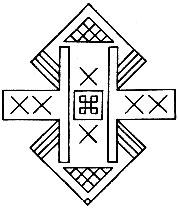
Images in the shape of two connected Terracotta with a little four-sided shape at the connection. One Star and one chess triangle are at the top and bottom. There is a “T” Shape laying at two sides of the middle four-sided shape and contains two stars. There are two little terracotta’s inside the top and bottom corners of two main terracotta. There is a little difference between these images and Chapat-e-Oshtor flower and are used in patterns other than Chapat-e-Oshtor.
|
|
Sign
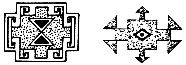
An absolutely conventional image, which is woven in rug, kilim and needle-work as a family, nation or tribe sign. It is usually made of one lozenge or a quadrangular shape with Projections like Morghak, hook or a short line. Some of signs are called Seal (Mohr) in Systan.
|
|
Sign
1- Margin consisting of repetition of sign and tiny basic images like Latteh, Pentagon and Triangle.
2- Pattern of bolster, silique or other small types of rug which its main basic image is signed lozenges-usually with a small lozenge in the middle-and next to its margins are also some triangles containing half-sign. In every lozenge there is a sign with a different color from the ground. Margins are usually lozenge and lantern, star, lozenge flower, wavy, Kajak, litter and Jovak colors are usually limited in number and navy blue, red, yellow, orange and white are mostly used.
|
Sign lozenge
Basic image in the shape of lozenge, with two Saucers at top and bottom corners; Morghak shape projection placed at two other corners, which are usually used as middle image and make it like a sign.
|

|
Single-Flower
1- Pattern with only one Medallion. Sometimes Medallion is so large and occupies the whole ground and leaves only four corners.
2- Pattern with only one repeated basic image, such as vase.
|
Square
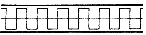
Margin formed by repetition of title squares, which are arranged two by two at both sides of a line, in the middle of margin.
|
|
Star
A type of Khalak in the shape of a tiny star.
|

|
Star-like
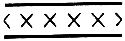
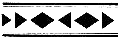
1- A basic image with repeated cross.
2- Repeated triangles and lozenges one after the other.
|
|
Straw
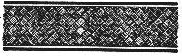
Margin in the shape of straw bands which are woven together.
|
|
Sugar-bowl’s flower
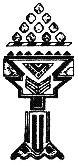
Basic image in the shape of a tall dish, which is resting on a stand and contains fruits or sweets in form of ten ovals, all together make a cone. There are usually, two decorative basic image at two sides of flower. This basic image is also called “Sugar-lump”.
|
|
Sugar-bowl Flower Pattern
The main basic image is sugar-bowl’s flower, which is repeated in ternate or foursome rows. In the space among them, there are hanging-lamp, connected chess triangles, Parreh-Jolaki and Boss. Margins are usually lozenge Four-short branches, lantern, Bride’s eyebrows, Kajak and Modakhel.
|
|
| ******************************************** |
|
Designs:
|
| A
B
C
D
E F
G
H
J
K
L
M
N O P R
S
T
V
W
|
|
|