|
|
Carpet is usually woven on vertical looms, but in some villages and tribal parts they use
horizontal looms. First of all, a wrap is spread on the loom by a skillful wrap-winder and a
kooji wood is winded on the wrap to separate the wraps. In addition to kooji a back loom
wood stays between wraps which are separated in two groups.
In bi-directional wraps the weaver sits before the loom and the woven carpet turns around on the loom, driven to the back of the loom; but in unidirectional looms, weaver sits on a bench and goes higher wale by wale.
At the start, before main weaving, a few wales are woven; simply and without pile which is called shawl weaving. After weaving a part of the carpet, they descend it by wrap runner. Although method of wrap winding in Hamadan is mostly Turkish, and a few instance is Persian, but texture is mostly with Turkish knot and by the hook.
In this region, collective workshops are almost gathered or come to minimum number, then,
carpet weaving is carried on unit-weaving and most weavers are women.
In large carpets with image, there is usually an image writer and a senior weaver. The writers have an important part in Hamadan big workshops; each writer is in charge of one or two looms.
The writer, cooperates with a few apprentices. He writes and corrects the plan, in addition to weaving carpet. He reads the colors and number of each color in louder voice and the weavers obey his instructions.
Senior weaver is a person skillful in weaving, a technical responsible and manager of
workshop. Duty of new trainees is filling up the emptiness between the two knots applied at the end of each color.
Double-knot weaving, wrong weaving and lack of weft are troubles seen in abundance in this region. The gross texture and single weft carpets quickly prepared are scarcely washable after weaving but finely texture which stays for a long time on the loom could be washed frequently.
Sizes most desired in Hamadan are 6x2 m or 3x1.5 m, then comes 2 zari (each zar=104
cm) and 1/4zar(1/4 zar = 26.5 cm) . Other sizes such as Kharak, Kenareh (runner), Poshti and Rukorsi have not many customers.
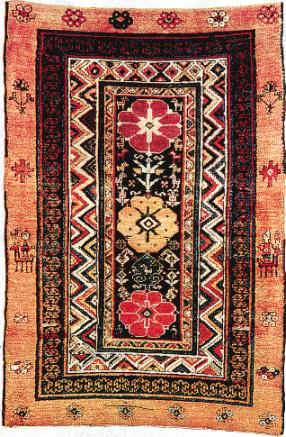
1.72x2.90 cm. (1904)
|
|