|
|
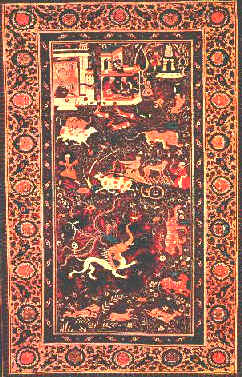
Indians could be considered as the symbol of great interest in handicrafts specially in weaving. Because of hot weather and usual humidity of India, piled carpet weaving and its usage have not become common. Carpet weaving in India, is also a rural and domestic handicraft, which is mostly done for export purposes.
Iranian weavers were the originators of carpet weaving, with Iranian designs, in this country. These designs besides the high quality of Cashmere wool, resulted the flourish of Indian carpet. India is one of the most important countries in silk carpet exports. Dyeing is an old industry in India and carpets have usually mild colors, which are mostly ordered by customers.
Dimensions of hand-made carpets depend on customer’s order, but common sizes are:
Carpet: 2.74X1.83 to 4.57X3.66
Rug: 1.83X0.92 to 2.14X1.22
Most of Indian carpets are bellow “26” wales and only 5% of them have “32” to “40” wales number. Knots are asymmetric Persian type.
Nowadays, the general design of hand-mode carpets in India, is a collection of Iranian, Chinese, Moroccan, French and Turkmen patterns, which are drawn in any size by skillful local designers and woven by weavers. 65% of Indian carpet designs are Iranian, like Sarough, Hamadan, Tabriz, Kashan, Isfahan, Khorasan, …., 15% French and the rest 20% are simple images.
Some of common Indian carpets are as follows:
Agra: A thick type of carpet woven by wool and cotton in blue, green and brown colors.
Asam: Small prayer-rug made of special white wool, which is used for worship and pray in India and Pakistan.
Dilara: A type of poor quality cotton hand-made kilim, which is woven in Punjab.
Darmi: It is an ancient type woven like a mat.
Harami: Various types of large carpets, which are woven for mosques.
|
|