
|
1871: March 19, Marx and Engels learn of the proletarian revolution that broke out in Paris on March 18. March 19 to May 28, Marx and Engels organize mass workers' demonstrations and a broad campaign in support of the Paris Committee proclaimed as a result of the victorious revolution in Paris. General Council discusses the events in Paris. Marx and Engels maintain constant contact with Committee and help Communards with their advice. March 21, In a General Council meeting, Engels speaks on the revolution in Paris. March 28, Festive proclamation of Paris Commune. March-April, Commune adopts decrees on the abolition of levies and substitution of armed people for a standing army, on the transfer of administrative power in the districts of Paris to Commune, on the separation of Church from State, the hand-over of workshops standing idle to workers' producer cooperatives, and others. April 12, "Volksstaat" publishes Engels' article "On the Cigar Makers' Strike in Antwerp", which calls on German workers to aid the strikers. April 18 to May 29, Marx works on "The Civil War in France", an address of General Council of the International showing the world-historical importance of Paris Commune as the first attempt in establishing a dictatorship of the proletariat, as a prototype of the future socialist state. May 9, in a General Council meeting, Engels reports on Paris Communards' resistance to Versailles troops and on the strikes in Spain and Belgium. May 30, International's General Council unanimously approves Marx' address, "The Civil War in France". It is published as a pamphlet in English and in a number of the International's newspapers. June-Dec., Marx and Engels organize support for emigre Paris Communards. June-Nov., Engels exchanges letters with Carlo Cafiero, a leading figure in Italian revolutionary movement, and through him influences Neapolitan section of International. Sept. 17-23, London Conference of International Working Men's Association, with "political action on the working class" the main point on its agenda. A controversy ensued over this issue with the anarchists and trade union reformists. In September 21 sitting Engels demonstrates necessity for proletarian political action and for an independent proletarian party in each country. This is put down in a resolution of the Conference. Nov. 25, with Bakuninists gaining influence in Spain, Engels writes a letter to Spanish Federal Council of International in Madrid refuting Bakuninist slanders against the General Council and London Conference. Nov. 29, Engels draws up a General Council statement to the editor of "Il Proletario Italiano", showing the importance of political action for the emancipation of working class. 1872: March 5, General Council of International Working Men's Association approves a private circular, "Fictitious Splits in International", written by Marx and Engels, which exposes Bakuninist intrigues, double-dealing policy and disruptive activity in International. April 24, Engels sends his first contribution to "La Plebe", an Italian socialist newspaper. May, General Council's private circular, "Fictitious Splits in International", which is written by Marx and Engels, comes out in Genova and is distributed to sections and federations of International. June 26 to Feb. 22, 1873, "Volksstaadt", the central organ of Social-Democratic Workers' Party of Germany, publishes "The Housing Question", a series of articles by Engels. Sept. 2-7, Marx and Engels take part in Hague Congress of First International. It confirms the main resolutions of London Congress and censures the disruptive activity of anarchists. It expels their leaders from International. Congress resolves to transfer the seat of General Council to New York. October, Engels writes an article, "On Authority", which he sends to Enrico Bignami. Oct. to August 1873, Marx and Engels systematically correspond with leaders of International in USA, Spain, Italy, GErmany and other countries, explaining the resolutions of Hague Congress. 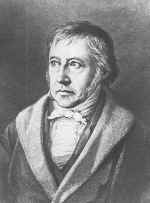
Georg Wilhelm Friedrich Hegel Berlin, 1840
|
|
© Copyright Caroun.com. All rights reserved.