|
|
Some Features of Iranian Music
Yalda Mahmoudi
Reprinted from: Honar Nameh, University of Art, Tehran, No. 1, 1997 (A brief of the article)
One of the earliest Islamic era texts of Iran, that of "Ikhvalol Safa" (Brethren of Purity, 11th century) makes references to early Iranian music. In the view of the members of this group of scholars, music was considered an art, whose essence is spiritual in nature. The treatise also makes references, after Pythagoras, to the numerical order in the universe and in music.
Iranian are one of the first people to possess music, as indicated in a seal, dating from the third millennium BC. Major portions of Zoroastrian Avesta consist of poetry that was meant to be sung and accompanied by music.
Iranian musicians developed many musical instruments, such as Barbat (Tambour), Nei (Reed Flute) and Chang (Harp). Many Indian instruments also bear Persian names as Vina, Sitar, Rabab, Yek-tar, Tamburi, Kinnari, Tablah, Nagara, Dhol...
Musical intervals were major concern of the early musicians, and Iranian music characteristically contained quarter tones. Early Muslim musicians received these concepts through translation of Greek and Syrian texts, but soon made their ownoriginal contributions.
Of the two principal modes in western music, namely physical or natural (i.e. harmonic) and diatonic, the former originated with Aristonexens, later developed by Ptolmei and still later by Al-Farabi, and it was designated as the preferred mode by Zarlino, and it remains the basic of Iranian music of today.
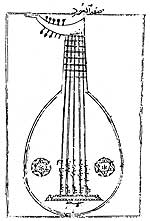
Oud
|
|