|
|
a) Images and Ornaments of Enamel-less Crockery, which are divided into three categories:
1- Engraved: Like geometric designs, wavy, zigzag, dotted, parallel and vertical lines and botanic images.
2- Additional images: Image, which is connected to crockery after fabrication as a separate ornament.
3- Molded images: This is called to images and designs, which are achieved with a mould of negative image. Following, the ready crockery is laid inside the mould and image is reflected on it. These images are miscellaneous such as geometrical designs, human images, animal images, plants, and sometimes together with old calligraphy such as “Solse” or “Kufi” manuscript.
Images mostly consist of dancing or musical scenes or running animals in forest, as well as geometric designs, such as rectangular, triangles, circles, and also botanic designs, such as cypress tree, foliage and arabesque flowers.
b) Earthenware with Clay Covering
Clay covering or slip as an ornament covers the earthenware in various colors, which was in vogue in Iran since 9th and 10th century A.D., and its colors has been mostly in white or milky. This earthenware is divided into the following groups considering ornamental designs:
1- Earthenware with black design on white ground:
This earthenware is covered with clay, covering and decorated with black or dark brown designs, added with transparent lead enamel.
2-Earthenware with multicolor designs on white background:
These kinds are called “Sari dishes”, “rustic” or “colorful dishes”. Colors like purple, black, dark brown, yellow and ruddle, as a thin layer on an opaque ground and finally a slip is applied on dish.
Images are various, such as animals, birds and fulfilled circles. Feature of these earthenware are as a bowl, plate and cup with an overturned edge, convex body and annular bottom.
3- Earthenware with golden imitation ornament:
These earthenware are dishes, on their clay covering, before baking, colorful enamel combined of metallic oxides are applied. Consequently, this type finds a very luminous covering after baking, similar to golden dishes, and generally is made as bowls and sometimes along with “Kufi” designs.
4- other group of clay-covered earthenware is those dishes, which are dressed up by makers after clay covering and trimming with black images and another adornment (generally in yellow). These are prepared as bowl and plates.
c) Earthenware with Sprayed Enamel
This kind is graffito of 8th century A.D. and coincides with historical era of “Tang” in China. On those days, making of this kind of earthenware was in practice in China, and owing to the good relation between China and Iran, this art was adopted by Iran. These dishes of ornamented-enamel sprayed have two species:
1-Earthenware with sprayed enamel:
First it is covered by clay enamel, then with lead enamel and dyes, produced from metal oxide combinations, cover the dish, whether as stain or dotted covering.
In China, they mostly used green, blue and amber-colors, but in chinaware of Iran, in addition to these colors, they use purple as well.
2- Earthenware with sprayed enamel and engraved design:
It is an innovation of Iranian Artisans: They dress up the main surface, before the main enameling, by utilizing engraved designs, and then cover dishes with main enamel.
Engraved images consist of botanic images, arabesque, scattered lines and scarcely images of birds. Earthenware paste with sprayed enamel mostly has a buff or red color, and the feature of pot is spiral bottom, with convex or lengthened body.
Crockery with engraved design
Origin of this kind goes back to Egypt, transported to Mesopotamia and Iran. Archeological excavations, such as “Keesh” in Iraq, “Festat” in Egypt, “Bamian” and “Lashgari” in Afghanistan and “East African Coasts”, discharged many samples of engraved crockery.
In Iran, these engraved earthenware have divided to various groups, such as “Amol”, “Agh Kandu”, Shamlou” or “Garous”, considering their technique and make. In the first two kinds, engraved designs are performed on the multicolor enamels, such as green, yellow or purple; then some special spots of dish are painted. This latterly painting would be for prevention of scattering or escape of other colors. Afterward, the entire dish could become covered with transparent enamel, like lead enamel.
In other kind, “Shamlou” or “Garous”, earthenware at first is covered with white clay covering under the lead enamel; then many spots of surface are dressed up by engraved designs. Consequently ornaments become beautiful in feature and coloring.
In next stage, pot (or dish) is covered with green enamel or transparent enamel of lead. They utilize, usually a green, yellow, brown and sometimes light red color, appeared in images of animals, birds, human being and sometimes in “Kufi” manuscript.
On the background, some scroll-shaped flowers are added. External surface of earthenware, usually has engraved design, without enamel, in some instances covered by greenish enamel.
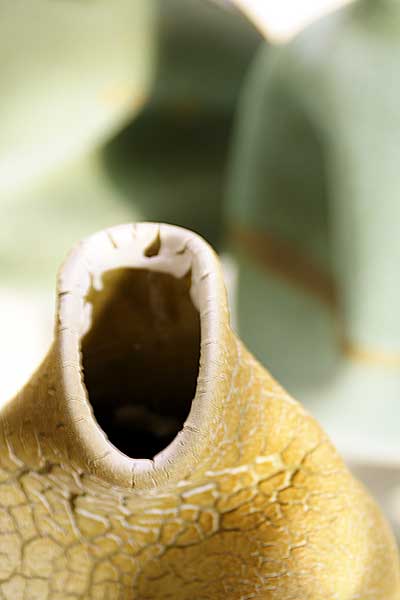
Photo by: © Masoud Soheili
|
|