|
|
Address: 11 WEst 53 Street, Manhattan
Phone: (617) 253-4444
Opening Hours: 10:30-19:30
website
New York is a city with more than 750 galleries. Many of these galleries are devoted to modern and contemporary art. New exhibitions go up about every six weeks in galleries and about every three months in museums.
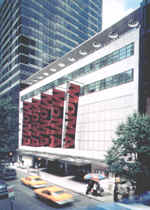
Museum's foundation goes back to 1929. It was in November, when the museum opened its doors to the public. Based on Bauhaus notion of the interrelation of arts, the collection came to encompass different aspects of creativity. Thus today, objects in the collection come under the supervision of six departments:
Painting and Sculpture, Drawings, Prints and Illustrated Books, Architecture and Design, Photography and Film and Video. At any given time, visitors have the option of viewing several exhibitions mounted by various departments.
Forward looking, this was the first museum to recognize motion picture as an art form and to have begun collecting and preserving films as early as 1935. Now, with more than 13000 films, it has the strongest international collection in United States. MOMA was also a pioneer in recognizing photography as an art form.
The key figure in this enterprise was Alfred H. Barr, who at the age of 27 became the first director. Before his appointment, Barr had been the first person to teach modern art in an American university and his course essentially contained seeds for the ideas he was develop in the museum.
For several decades, Barr's view influenced the way modern art was defined. His standards of scholarship continue to be followed specially in Museum's publications, the most important of which are catalogues accompanying every exhibition. These are not mere checklists of exhibited works but laborious productions with major texts, abundant illustrations and scholarly material.
What attract 1.6 million visitors every year to this museum is the permanent collection combined with the series of contemporary exhibitions. Relying on private funding and in almost 70 years of its existence, MOMA has formed an unparalleled collection of 20th century art, which it continues or refine with new acquisitions.
Providing a synoptic view of art in 20th century, this collection begins with works by the generation of artists known as Post-Impressionists, who came to maturity in 1880s. These artists (Cezanne, Van Gogh, Gauguin and Seurat) did not constitute a school nor were they bound by a common style, but each, after a brief impressionist phase, carved a direction which became crucial to the development of art in 20th century.
One of the most popular paintings, in this section, is "Starry Night", painted by the Dutch artist Vincent Van Gogh, from his window at the asylum in South of France, where he voluntarily committed himself in 1889.
|
|