|
|
Address: Fin Garden, Kashan, Iran
Tel.: (+98) (21) 4477
Opening hours: 8-18; Sunday to Thursday
Type of Museum: General
Type of Objects: Archeological, Ethnological and Crafts
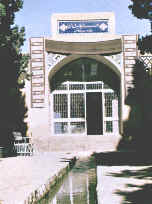
Fin Garden is a Palace that combines the architectural features of Safavid, Zand and Qajar periods. It counts among the most beautiful ancient parks of Iran as regards its location, bountiful natural fountains called Solomon, numerous old trees, pools and stream of water.
Kashan Museum was erected in the western part of Fin Garden, upon the order of the late Seyed Mohammad Taqi Mostafavi, former Director General of the Archeological Department.
This building consist of large and small halls and a vast basement. It contains archeological, ethnological and crafts. The archeological objects were excavated in Tappeh Sialk, Choqa Zanbil, Hassanlu, Khorvin, Lorestan,..
The building, housing Kashan Museum, was built in 1968, in harmony with the historical monuments within Fin Garden, covering 900 sq. m and comprising eight vast galleries, each displaying items from Iranian culture and civilization in various historic periods.
In Gallery one, artifacts discovered in "Sialk Hill" (Kashan) and "Ismail-abad Hill" (Savojblaq, Karaj), dating back from late fifth millennium to early first millennium B.C., are exhibited.
Most of the objects from "Sialk" are earthenware. Items from the first stratum are scare. Those from the second stratum are mostly brick-red, whereas those from the third stratum speak of a distinct progress in materials and decorative patterns. Most of these are buff-colored and decorated with animal motifs. The evolution of "Sialk" civilization could be clearly assessed by viewing the objects from 6th stratum, such as various pottery items, decorated with all kinds eye pleasing motifs, bronze and silver utensils, dating back to the early first millennium B.C.
"Ismail-abad Hill" counts among the significant residence spots of Iranian prehistory. Artifacts unearthed from the tombs of this site include vases with a base, bowls without base, basket-like vessels, narrow-rimmed bowls and conical jars generally made of earth and decorated with black motifs.
In Gallery Two, artifacts discovered in Susa, Azerbaijan, Khorvin and Lorestan, could be admired.
Situated 3 km to the East of Karkheh River, Susa was originally the capital of Elamites, and later became one of the capitals of Achaemenid Monarch. Artifacts, gathered in the ruins of Susa, are divided in two groups, according to civilizations from which they were originally derived:
Susa I, whose artifacts date back to 4000 years B.C.
Susa II, whose artifacts, including ceramic goddess figurines, metallic ornamental objects and bronze tools and utensils, belong to 2000 years before B.C.
Khorvin is the name of a village situated 80 km to the North-east of Tehran. Artifacts from this region have mostly been discovered in a cemetery on a hill, close by this locality. One of the most interesting among these, is a vessel decorated with four animal heads. Artifacts, unearthed here, relate to 1000 years B.C.
4000 years ago, in Lorestan, in the fertile valley of Zagros range, lived a turbulent tribe known as Cassites. Its men often invaded Mesopotamian plain, threatening Babylonian Empire. Ultimately, during 18th century B.C., they conquered it, and were able to reign over it for 5 centuries.
Artifacts obtained from this region display the taste, arts and civilization of this mountain-dwelling tribe.
Later on, arts of Cassites were imitated by other tribes, living on Iranian plateau. Attractive bronze objects, discovered in their tombs, show that they used to inter the weapons of the deceased together with their owners.
On show in Gallery Three are ceramic, bronze and stone objects left behind by Parthian and Sassanid, and discovered during excavations made in Garmi (Azerbaijan), Susa and throughout Guilan province.
Parthian was an Iranian tribe, who defeated Selucid and installed the reign of Arsacid (Ashkani) dynasty, by Ashk in 520 B.C. Between Alexander's invasion to Iran and the reign of the last Arsacid monarch, that is for some five centuries, a new art combining Greek and Iranian elements flourished. During this period, sculpture acquired importance.
Sassanid dynasty was founded in 226 A.D., by Ardeshir I (Babakan). Sasaanid considered themselves the descendants of Achaemenid, and therefore tried to revive Achaemenid arts. Thus, they were interested in chiseling and carving scene of hunts, wars or festivities on silver or stone.
Other artifacts exhibited in this gallery include gold and silver coins from Parthian to Zand period.
The first king to install the use of coins in Iran, was Darius I, Achaemenid Emperor. Pre-Islamic coins bore effigies of kings and rulers, whereas in Islamic period, there were replaced by writing on both faces of coins. During Qajar era, effigies of kings once again appeared on coins.
In Galleries Four and Five, antique precious artifacts (after Islam) are to be viewed. After Arab invasion to Iran, Sassanid arts continued to flourish here and there throughout the country for some 300 years, and then was the time that it was influenced by Arabic signs, due to the new social conditions.
During this time, regions of Susa, Istakhr, Rey and Gorgan were centers of ceramic production. In these, ancient traditions were combined with new methods. A new style was created by decorating vessels with inscriptions in Kufic script. Alongside simple calligraphic decoration on vessels, polychrome decoration on white background, also came into being, and soon acquired outstanding fame. Various examples of these, which have been discovered in Neishabour and Susa, belong to 9th and 10th centuries A.D. During Seljuk and Mongol periods, art of ceramic production reached its peak of perfection.
In the course of 12-13th centuries A.D., production of enameled glassware flourished. Carpet weaving, ceramic production and metalwork acquired exceptional vogue in Safavid period.
Durind Zand and Qajar periods, oil painting became current practice, and the use of this medium in decorating papier mache and wooden objects such as mirror-cases, boxes and pen-boxes became quiet popular.
In Gallery Six, specimen of calligraphic works by Qajar artists, in script such as Nastaliq, Nasq and Shekasteh-Nastaliq are exhibited.
In Galleries Seven and Eight, contemporary handicrafts of various regions of Iran are displayed. Among these, porcelain were deserve special mention. Also, figurines clad with typical garments of various regions of the country are particularly attractive.
Other parts of these galleries comprise display of fabric, ceramic and wood inlay crafted by artists of Fine Art Workshops, as well as works by local Kashanian artists and gifts donated by art-lovers. In the end of this part, Iranian Ethnology section is displayed.
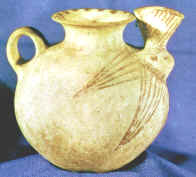
Buff-colored pre-historic ceramic jar, "Sialk Hill", Kashan
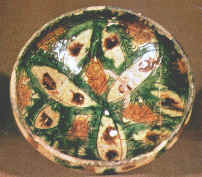
Enameled Ceramic bowl, Neishabour, 9-10th century AD
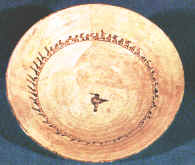
Ceramic bowl, buff-colored background, Neishabour, 9th century AD
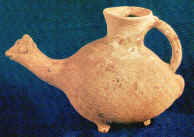
Brick-red ceramic vessel, Garmi, Azerbaijan, Arsacid period
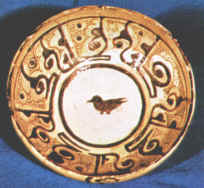
Enameled ceramic bowl, Neishabour, 9th century AD
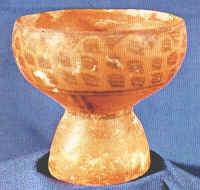
Large reddish ceramic goblet, Ismail-abad, 1st millennium BC
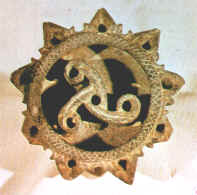
Tallow lamp of stone with inscriptions in relief arount its rim and body, Neishabour
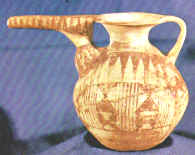
Reddish ceramic vase with handle and spout, Sialk, Kashan, BC
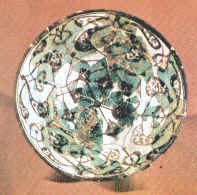
Buff-colored pre-historic ceramic jar, "Sialk Hill", Kashan
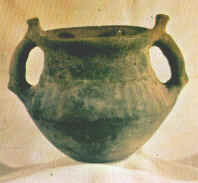
Fluted black pitcher with two handles, Hassanlou, Azerbaijan
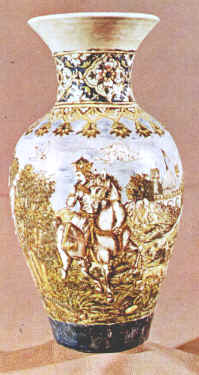
Flower vase with relief miniature painting on turquoise background, Traditional Arts Workshop of Arts & Culture Dept.
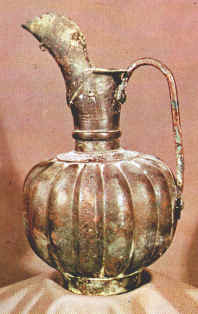
Bronze pitcher with handle and bent spout, Khorasan. 14th century AD
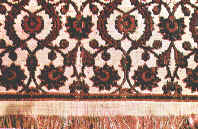
Velvet, Traditional Arts Workshop of Arts & Culture Dept., 1985
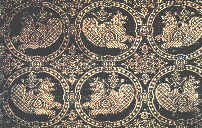
loral brocade, Traditional Arts Workshop of Arts & Culture Dept., 1985
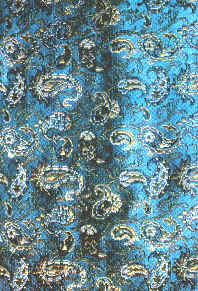
Brocade with carnation flowers, Traditional Arts Workshop of Arts & Culture Dept., 1971
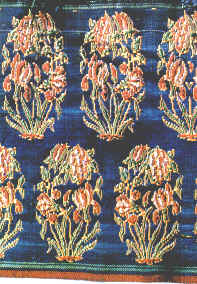
Brocade, Traditional Arts Workshop of Arts & Culture Dept.
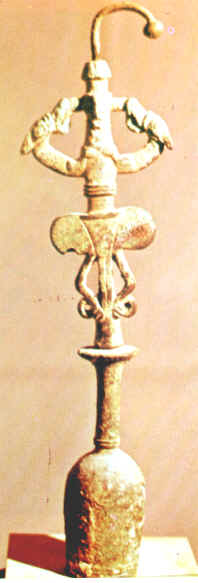
Bronze idol, Lorestan, 1st millennium BC
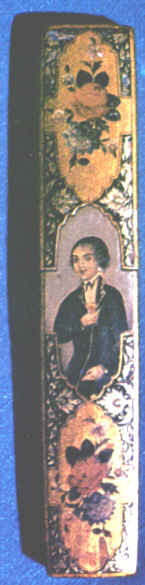
Lacquered stamp-box with floral patterns and an illuminated portrait, 10th century AD
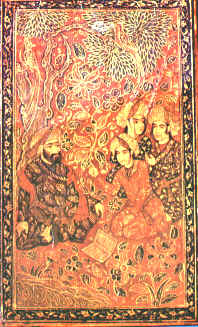
Miniature painting in the manner of Reza Abbasi, 19th century AD
|
|