|
|
A) In Iran Bastan Museum (National Museum of Iran), ceramic, glass and metal cupping-glasses manufactured in workshops of Rey, Gorgan and Neishabour, during 9th and 10th centuries A.D., are exhibited.
Those shape is similar to that of a drinking glass, with rounded bottom and smooth rim, tapering into a tubular end.
Horn-like shape of these medical instruments has caused it to be called as such.
Glass cupping-glasses are of the blown type and no adornment is visible upon those.
B) Other glass items on display include specimen preserved in Glassware and Ceramic Museum of Iran (Abguineh):
1- Medicine container of thin glass, height: 13.5 cm., North-west of Iran, 2nd-3rd century A.D., Arsacid period.
2- Medicine container of thin glass, height: 7.6 cm., North of Iran, 2nd-3rd century A.D., Arsacid period.
3- Cupping-glass, iridescent, rim diameter: 3.7 cm., Khorasan, 13-14th century A.D.
4- Cupping-glass, iridescent, rim diameter: 5 cm., Khorasan, 13-14th century A.D.
5- Glass laboratory container, iridescent, length: 19.5 cm., Neishabour, 10-11 century A.D.
6- Glass medicine mortar, diameter: 4.8 cm., Gorgan, 11th century A.D.
7- Glass medicine mortar with square rim, length: 11.7 cm., Gorgan, 10-11th century A.D.
8- Glass laboratory container, iridescent, length: 18.5 cm., Neishabour, 13th century A.D.
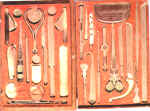
C) Also among lacquered preserved in Reza Abbasi Museum, A barber's toolbox from 19th century, signed "Sadeqolvadeh" and decorated with flower and bird motives, could be admired. Inside it, complete panoply of a barber could be seen.
|
|