
|
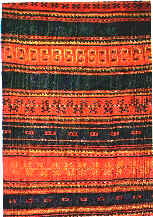
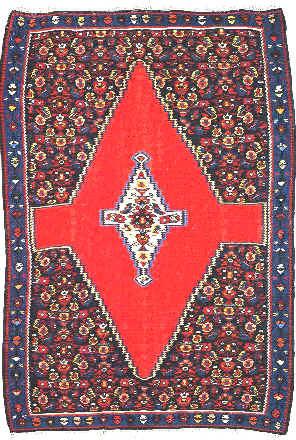
Bio-data of this clan is very old and ancient. Kurd title was given at first to the local tribes and unions of Western Iran around (640 B.C.). It was a vast land consisting Armenia to Zagros Mountains, and from Euphrat to Isfahan. The extra scattering and the large area of region caused great differences in textures, colors, designs and even weaving. One may refer to beautiful silk kilims of “Senneh” with highest fame and near similarity to traditional carpets of Iran or woven curtains and wall-covers as follows: Senneh (Kurdistan) Senneh is the origin of the most famous Kurdish Kilims in region of Sanandaj and its environment. This city was the capital city of Kurdistan since Safavid Kingdom and a center of carpet and kilim weaving. The influence of Safavid Kingdom, may easily be seen in designs of kilims and carpets of Kurdistan. Kilims of Senneh resembles the Mongolian carpets, but their designs are adopted from Indian textile. Technically, kilims of this region is quite different than other kilims woven by tent-dwellers and are divided into 3 categories in combination: 1- Repeatedly flowered designs or one flower design suspended by a nail from loom surrounded by a narrow margin or a group of margins. 2- Flowers are finer and the separated medallions stand in center. This kilim is similar to the knotted carpets called “Barati”. 3- Prayer rugs having a bulbous shaped altar varies from prayer rugs of other countries. Considering the fact that designs of other countries are used in these kilims, only the artistic skill of the weavers remains as an outstanding point. General specifications of Senneh kilims are : Ground design: Endless repeating of floral design on the entire ground, flowered design inside the middle medallion Margins: Numerous and floral Size and Feature: Normally small and rectanguler, some big and round with Materials: Yarn warps, fine woolen weft Texture: Extra fine slit wearing, extra enclosed weft, curved wefts Fringes: Knotted networks, in groups Selvages: uniform (One of the limited Iranian clans that weaves prayer rugs). Bijar of Kurdistan Weaving this kilim is appropriated to Bijar and its suburbs. Some of these kilims are simple copies of Senneh with a coarse wool and dark colors. Some unique and outstanding kilims of this kind have slit, woolen weaving and yarn warps. Kilims of this region could not be easily distinguished from western kilims, such as Shahsevens; they have mostly two margins: the outer margin shows a marvel-of-peru, at face. Other specifications of these kilims are : Ground Design: Geometrical medallion (relief) on a simple ground Margins: Narrow Size and feature: Long and narrow Materials: Coarse wool, sometimes yarn warps Weaving: Slit Colors: Various hard colors Fringes: Various Selvages: Uniform, parallel spiral (Weaving human-animal images) Bijar Kurdistan dyeing depends directly on the following factors: 1- Type and quality of warp and weft 2- Modality of spinning 3- Chosing color 4- Modality of dyeing materials For dyeing, it was some materials in the past, such as Sumac root, madder, granatum, grape leaf, onion cortex, turmeric, walnut leave and other natural materials for dyeing; at present, having synthetics in the market, natural dyeing is forgotten and synthetics are used for accelerate and facility of work; natural dyeing is scarcely applicable. Khorasan’s Kurd They can be divided in two clans: 1- A tribe from Elazig in Central Anatolia 2- A tribe from Karabag Both have escaped into Iran. Some of them have stayed in the mountain slopes of Taleghan. They are ancestors of “Rashun” Kurds. The other group have resided at margin of “Kavir” plain and have called themselves as “Chamis Ghazagh”. Khorasanian Kurds utilize very various designs, colors and techniques in their weavings; meanwhile one could find some effects of their Anatolian-Caucasian ancestors in their designs. This must not be ignored that their hand-made designs are multi featured because other races are living in their side. Kilims of Khorasanian Kurd somewhat resembles to the weaving, of “Ghaleh – No’ in North-West Afghansitan. This region is famous for abundant producing of “bag-rug”, “Maffrash” and “Namakdan” (salt-container). Specifications of kilims woven by Khorasanian kurd are: Ground Design: Miscellaneous designs, utilizing some motives of Caucase and neighboring clans Size and Feature: Miscellaneous Material: Wool wraps, soft wool wefts Weaving: Weft faced patterning, spiral weaving Colors: Dark and plain, light brown, light orange Fringes: Miscellaneous Selvages: Uniform, parallel spiral (Rug-bag, ornamental objects and table-cloth are also made.) 
|
|
© Copyright Caroun.com. All rights reserved.

