|
|
Jajim Weaving
Jajim or Jajem means a “Thick cloth” like “palas” and also a kind of two-sides carpet, which is thinner than Palas. Jajim is woven with colorful and fine threads of wool or mixture of silk and wool. It is a hand weave with no fluff and its two surfaces could be used. It is a tribal weaving and used as a coverlet or protector from coldness.
Before coming of quilt and blanket, Jajim has been the only coverlet of tribesmen. Although it is rough and coarse, it will become fine and delicate by continuous use very soon.
Weaving of Jajim is simpler than kilim and more common, as well. A common Jajim with 2.5 meter length and 2 meter width could be woven in less than a month by two weavers, otherwise rug that has millions of knots or kilim that has tens of motifs in several colors.
There are fine Jajims woven in tribes, which have 3 to 4 mm thickness. These Jajims are used for decoration.
Jajim, like kilim, is woven on horizontal loom. According to the pattern, which weaver has in mind, colorful warps with certain space have been prepared, on loom. Hand spun and fine wefts, prepared by tribe women, passed through warps and beaten by a comb, to be pressed. Warps make images of Jajim. Wefts are not seem very much.
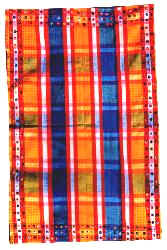
Common Jajims (Chahar-Koub) are like light and dark checkered in different colors. Motifs could be stripped, square, checkered, toothed, plain and parallel lines, and generally all motifs are along warps.
In “Qashqai” tribe, Jajim is also woven as needle lace ( called “Rend”) and its motifs are the same as kilim. These Jajim are mostly common in “ Kashkouli” and “Dareshori” tribes.
Common Jajims could also be woven in two pieces or more. It means, that a narrow stripe with 5 meter length and 1.5 meter width, is woven; then divided into 2 pieces. These 2 pieces are sown together side by side. Salvage in between hides the sown points. These Jajim are called “Double Width” and could be woven ever by a weaver. If weavers are more than one it is better to be woven in single width. Today it is woven with the width of 20 to 30 cm; mostly five parts sown together, made Jajim.
|
|