|
|
"In old Russian notions, the gardens ranked among the greatest values on Earth”, said Academician Dmitry Likhachev, well-known expert in national history and art.
As is known, back in 15th century, Tsar’s Garden was opposite Kremlin. It lay along the other bank of the Moscow River.
During the reign of Ivan the Terrible, on the site of the present Alexandrovsky Garden, there was the so-called Aptekarsky (Medicinal) Garden. This garden lay on the right bank of the Neglinnaya River, between the Trinity and Borovitsky Gates.
Landscape gardening in Kremlin is considered to have “bloomed” in 17th century. The list of Kremlin gardens mentions the “upper” and “palace” gardens, and the “room” and “embankment” gardens. Obviously, gardening was very popular amongst the Kremlin dwellers as it met their aesthetic tastes. Special attention was given to the “embankments” of the Upper and Lower gardens. Upper Embankment Garden was on the roof of the two-storied reserve palace of Boris Godunov. Lower Embankment Garden was also laid out on the roof of a building “next to the Embankment Palace” and ran “towards the Tainitsky (secret) Gate”.
The old tradition of arranging “hanging” gardens in palaces has been continued yet. On the eve of 1960, a Winter Garden was opened in a passage linking Great Kremlin Palace to the former Kremlin Palace of congresses. Its area is 320 square meters, of which exotic plants of more than 120 species take 110. One of the walls of the garden is made of glass letting in abundant daylight needed by the plants and, at the same time, opening a fine view of Kremlin buildings, as if uniting them with this luxurious collection of nature.
The now extant specimen of landscape gardening of the first quarter of 19th century is Kremlin Garden, renamed Alexandrovsky Garden in 1856. It was laid out in 1822-1823 along the west part of Kremlin wall. It lies above the old riverbed of the Neglinnaya River, now canalized and underground. The architect O.I. Bovet supervised the laying out of the garden. The iron gate of the main entrance and the fence with decorative bronze elements are made after E. Paskal’s sketches. The lower lateral fence along Manezhnaya Street was erected in 1934.
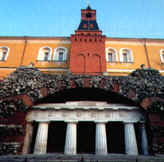
A typical feature of 19th-century landscape gardening is the grotto. The one set at the foot of Middle Arsenal Tower was erected on artificial mound and adorned with fragments of white-stone ornaments from dismantled structures. On the outer platforms of the grotto orchestra used to play on public holidays. In 1913, close to the main gate of the garden an obelisk was erected to commemorate the tercentenary of Romanov dynasty. In 1918, tsarist emblems and old inscriptions were removed.
In 1870, Tainitsky (secret) Garden was planted on South slope of Borovitsky Hill, and in 1926, public garden was laid out in the square between Arsenal and the former Senate building. There, an obelisk was erected in memory of Kremlin red guards who fell in battle during the civil war (1918-1920).
In 1940, Kremlin Large Public Garden was laid out on the site of the former dragoon drill ground, in South part of Ivanovsky square. There, Yury Gagarin planted an oak named “Cosmos” to commemorate the first ever space flight.
|
|