|
|
In 1960-1961, Kremlin Palace of Congresses was built on the territory of Kremlin, not far from Trinity Tower. The site chosen for the new palace used to be occupied by 19th century services buildings and the old building of Armoury built in 1806-1810.
Kremlin Palace of Congresses has been, and remains, the biggest public building in Moscow: It contains some 800 rooms varying in size; its useful area is 55,600 Sq. m; it is 73m wide at the perimeter, 121 m long, and 27 m high. The building is sunk under the ground to the depth of 15-16 m (which is the height of a five-storied apartment house). This has made it possible to preserve the peculiar historical silhouette of Kremlin complex. Besides stairways, the building has 14 escalators and 26 elevators.
The palace intended to be used for CPSU congresses, sessions of USSR Supreme Soviet, international congresses, major conferences and meetings. However, it could also be used for holding concerts and stage performances, festivals, banquets and balls.
The main room of the building is the conference hall, which is also the auditorium. At the time of construction, the hall was the biggest in Europe. Its area is 5,600 Sq. m; the stalls have 2663 seats, the amphitheatre 1569seats, and the balcony with the boxes 1770 seats. Hall is equipped with all kind of technical and radio devices, including those for simultaneous interpretation into 30 languages, which can be broadcast to any seat in the hall. The stage is also the largest in the world (2000). It has a proscenium, which is so designed as to be converted into an orchestra pit. On the back wall of the stage is a screen, which can be moved closer to the front part of the stage.
Above the conference hall there is the banquet hall for special receptions and festive soirees. It can seat 2500 people. On the days, when stage performances or concerts are held in the palace the hall is used as a buffet for the spectators.
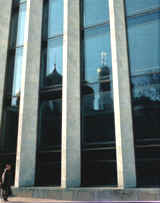
The main entrance of the palace faces Arsenal building. North façade of the building looks out on the former Palace Street and Pleasure Palace. The pylons are riveted with white marble. The glass panes reflect Kremlin buildings surrounding the Palace as if trying to conceal its true nature, which is so alien to old architecture.
The building and the installations of Kremlin Palace of Congresses were designed by a group of architects and engineers, including M.V. Posokhin, A.A. Mndoyants, E.N. Stamo, P.P. Shteller, G.N. Lvov, A.N. Kondratiev and I.I. Kochetov. The interior decorations are by many well-known artists, including the famous Soviet painter A.A. Deineka.
In the last years of 20th century, Kremlin Palace of Congresses was renamed State Kremlin Palace. Stage performances or concerts are held here nearly every day. State Kremlin Palace has its own young ballet company, which has won renown both in Russia and abroad.
|
|