|
|
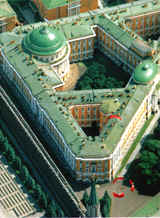
The Senate building is rightly considered a fine example of Russian architecture of 18th century within the complex of Moscow Kremlin buildings. The prominent Russian architect M.F. Kazakov designed this remarkable structure. The construction lasted from 1776 till 1788; the interior decoration was completed in 1790.
Originally, it was intended to hold the assemblies of Moscow Gubernia's nobility here. In 1856, in connection with the transfer of two Senate departments from St. Petersburg to Moscow, it was given to the judicial departments of the Moscow Senate.
This three-storied building has, in plan view, the shape of a blunt-ended triangle. Its inner space is divided by two straight archways thus forming three inner courtyards. The upper angle of the triangle is marked with big green dome. The Senate stands opposite Senate Tower, confronting the Mausoleum on the outer side of Kremlin wall. The dome of the Senate echoes another, smaller one, situated opposite the big one.
The main cupola was first crowned with Moscow's crest, an equestrian statue of St. George, which was replaced by the emblem of royal justice in 1856. In 1918, when the capital was transferred from Petrograd back to Moscow, a red flag was mounted on the cupola, now replaced by a three-colored flag of the Russian Federation.
The Senate building is a brilliant example of early Russian classicism in architecture. Outwardly severe and well balanced it reveals ample examples of the new style in beautiful décor. Big circular hall, recognized masterpiece of Russian architecture, is most impressive. Situated inside magnificent rotunda, this hall cannot be detected from the outside. Only gigantic cupola marks the location of this compositional center of the whole building.
Hall is surrounded at the perimeter by light columns and pilasters of Corinthian order supporting delicate furnishing in full profile. There is narrow gallery above it, with two tiers of plaster bas-relief replicas of portraits of the Russian princes and tsars placed between the windows. The famous Russian sculptor F.H. Shubin made their marble originals in 1774-1775, for Chesmensky Palace in St. Petersburg. One can see their copies in the halls of the Armoury.
White and blue walls, snow-white columns, blue upholstery, golden rosettes on the cupola, light clear lines, ideal proportions make this interior perfect artistically and architecturally.
Hall is 24.7m in diameter. At the height of 27m, it is covered by grandiose caisson spherical cupola rising over the delicate, even fragile, spherical circumference of the hall.
Over the door arches in the hall's lower part, there are high relieves with allergic scenes, which glorify Catherine II (sculptor G.H. Zamarayev). Hall was called Yekaterininsky (Catherine's) Hall up to 1919, when the hall was renamed the Sverdlov Hall.
The Oval Hall is situated under the second, smaller cupola of the Senate. It is also white-and-blue colored like Yekaterininsky Hall. On the cupola, along the longitudinal axis, there is high-relieves of St. George, striking the dragon. These crests are reminder of the fact that originally the building was intended for holding Moscow Gubernia's assemblies of the nobility.
After the revolution of 1917, there was a club for Kremlin personnel and students of the military college in the Senate building. In the spring of 1918, the capital of Soviet State was moved to Moscow. At the end of April of the same year, Lenin with his family, his wife and sister, moved to the former Senate building. His flat and study were on the third floor.
Since that time, the building has been the residence of Soviet government. Party congresses and conferences were held in Svedlov Hall. Highest government and state awards and Lenin prizes were also presented here. People's deputies' sittings took place here up to 1934, when Alexandrovsky and Andreyevsky Halls were specially rebuilt for 17th Party Congress. After that, party congresses and plenums of Supreme Soviet were held here.
In the Senate building was Stalin's study consisting of big reception room and small study. The destinies of the country and the people were dictated here. A famous screen with, large moving geographical map, is kept here. It is known to millions of people since it is seen on newsreels and feature films about the life of the governmental Kremlin. The first map of this kind was made on Lenin's instructions.
In the first year of 3rd millennium, the Senate building is occupied by the administration of Russian Federation President.
|
|