|
|
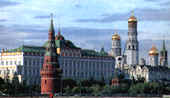
The Great Kremlin Palace is a masterpiece of Russian architecture of its time. It was built in the southwest part of the Kremlin, on Borovitsky Hill, on the site of the earlier residence of grand princes and tsars.
In the Middle Ages in Russia a “Palace”, formerly “Terem”, meant a complex of buildings with gala (reception) halls, living rooms, court churches, workshops and household premises.
The prince’s Terems in the Kremlin were first noted in the mid-14th century and were associated with prince Ivan Kalita.
The inexorable time and numerous fires did not spare the Kremlin’s old buildings. By the end of the 18th century many of them had fallen into decay. The construction of a new palace which would meet the requirements of the royal court began in 1838 and lasted eleven years.
The palace faces the Moscow River. A group of architects headed by Professor K.A. Thon (1794-1881) from St. Petersburg who was known for his ability to build quickly and well, was entrusted with the task of designing and constructing the building. The outstanding Moscow architects F.F.Richter, N.I.Chichagov, P.A.Gerasimov and others took part. Their talent and professionalism enabled them to cope with the complicated task of uniting several buildings belonging to different styles and different times (14-17cc.) less than one roof. Among them were the Facets Palace, the Tsarina’s Golden Palace, the Terem Palace, the domestic churches and a building erected in the 19th century.
Yet the interior is modern as regards its design and constructional concept. The exterior of the palace is designed according to a model typical of past centuries; the traditional approach is clearly expressed in the application of decorative techniques. The palace has carved white-stone pediments and double-arched plat bands on the window-openings with pendants suspended in the center (as in the 17th-century Terems). The main and the eastern faces of the building have terraces, which are reminiscent of an old-Russian gulbische (a gallery built on the basement around a house). The main entrance and the arch recesses of the south side of the building match well. The palace has a figured roof and a tetrahedral attic with a cupola on top.
The Great Kremlin Palace has surpassed many other European palaces in its grandeur and magnificence. Its main facades are 125m long and 44m high. There are about 700 rooms with a total area of almost 20,000 sq.m. There are two-storeys but three tiers of windows because of the two tiers of windows in the gala hall on the second floor. The socle of the brick walls is covered with gray stone and the cornices and plat bands are covered with limestone. The interior is decorated with national materials.
The Great Kremlin Palace is a unique example of Russian architecture of the mid-19th century. Elements of various styles, from baroque to classicism, were incorporated in the palace’s interiors, which are still almost intact today. Its décor is distinctly luxurious and perfectly executed.
The eminent artists and sculptors F.G.Solntsev, I.H.Vitali, P.K.Klodt and O.V.Loganovsky were involved in decorating the interior alongside architects. Furnishings were made after their designs at famous Russian factories and workshops.
The gala reception halls- named Georgievsky, Vladimirsky, Andreyevsky, Alexandrovsky and Yekaterininsky- are on the second floor of the Great Kremlin Palace. Their names correspond with the Russian pre-revolutionary orders whose elements are included in the stucco moldings in each hall. The upholstery is colored in correspondence to the respective decoration ribbon.
The Georgievsky (St. George’s) Hall is the largest and most popular of the gala halls. It was conceived as a hall of glory of the Russian army and is devoted to the military Order of St. George instituted by Empress Catherine II in 1769, one of the most honorable of the royal decorations. Inside, the hall is majestic and solemn. The light from the two tiers of windows floods the room and visitors are struck with its enormous size- the room is 61m long. 20.5m wide, and 17.7m tall. Relief work, sculpted and gilt bronze decorations adorn the snow-white walls and the vaulted ceiling. The hall glitters in the light of the many-tiered openwork bronze chandeliers and wall lamps set all along the cornices. The huge vaulted ceiling of the hall is held up by 18 massive pillars leaning against the twisted columns cast in zinc. Above their capitals one can see statues- the allegoric images of the regions, which joined the Russian state from the late 15th to the early 19th century (by the sculptor I.P.Vitali). The names of the regiments awarded with this order and of the Knights of St.George are inscribed in golden letters on marble plates on the walls and pillars.
Carved furniture is gilded and upholstered by watered silk of the same color as the decoration ribbon. There are relief images of the order symbols (the cross and the star) in the carved ornamentation of the walls and the vaulted ceiling. In the semi-circulars of the transversal walls there are high relief’s by the sculptor P.K.Klodt, depicting St. George on horseback. The magnificent multicolored parquet was made up of 20 valuable types of wood and was designed by the artist F.G.Solntsev. It looks like an enormous carpet covering the floor of the memorial hall. Nowadays this hall is used for celebratory meetings, award ceremonies and diplomatic receptions.
Besides the St.George’s Hall is the Vladimirsky (St.Vladimir’s) Hall devoted to the Order of St. Vladimir instituted by Catherine II in 1782. It was built on the site of the open Boyar Gallery of the 17th century. It links the palace buildings of the 15th-17th centuries with the later, 19th-century buildings. It is an octagonal room with the corners cut off and there are big broad arches in the low part. Above them is a tier of smaller arches where the choir gallery is situated. The walls and pilasters are covered with rose-colored imitation marble. The cupola-shaped vault is decorated with gilt ornaments and symbols of the Order of St. Vladimir (a red-enameled gold cross and a star). During the day the Hall is lit by the sun shining through the vaulted cupola and in the evening a large bronze chandelier lights up the hall. The pattern of the parquet floor which is made of rare species of wood (artist F.G. Slolntsev) is beautiful. Once again there is corresponding watered silk upholstery on the furniture.
The Andreyevsky (St. Andrew) hall was devoted to the Order of Saint Andrew instituted by Peter I in 1698. It was the Russian emperors’ Throne Hall. There was a throne at the East wall. On ceremonial occasions higher military officials met there. Hall has ten gilded pillars and gilded doors with the Order’s insignia, crosses and chains. Walls were upholstered in blue watered silk (of the color of the Order of St. Andrew’s ribbon) and are also decorated with chains and the symbols of the Order. There are emperors’ monograms, the monogram of Peter I, founder of the Order, the other one, of Paul I, who instituted the Order’s status, and the third one, of Nicholas I, who built the Alexandrovsky Hall, over the doors leading to it. There were crests of Russian gubernias and regions over the windows. Miller made Hall’s parquet after the Academician Solntsev’s design. Two tiers of windows, ten bronze chandeliers and 35 wall lamps light Hall. In the back wall, there are glass panel doors and false windows. The interior was decorated with two mantelpieces made of gray-blue jade. There was no furniture in the hall.
Alexandrovsky Hall was named in honor of the Order of St. Alexander Nevsky, instituted by Catherine I, in 1725. Its walls were covered with rose-colored imitation marble. A spherical cupola is supported by sail-like vaults and is decorated with the Order’s symbols and state emblems. Crests of Russian gubernias and regions were between the gilt twisted columns. There is a gilt steel framework of the Old Slav structure over the entablement of the upper columns, on each side of the doors and between the windows. Moller’s scenes from the life of St. Alexander Nevsky hang on the walls. Hall’s parquet is made from various types of wood after the Academician Solntsev’s design. The room has two tiers of windows, six chandeliers and 28 wall lamps. There are glass panel doors and windows in the back wall. Hall was decorated with four marble mantelpieces and gilded chairs (made by Touret), which were upholstered in velvet of the color of the Order ribbon. The upholstery on the back of the chairs is embroidered with the Order’s stars.
Anderyevsky and Alexandrovsky Halls were combined in 1934 and were equipped to hold sessions of the party congresses and the Supreme Soviet.
On the second floor of the West wing of Great Kremlin Palace, there is “Gala Half” suite: Yekaterininsky (St. Catherine’s) hall, Gala Reception Hall, Bedroom and Walnut Cloakroom.
St. Catherine’s Hall was formerly the Russian empresses’ throne-room. It was named in honor of the Order of St. Catherine instituted by Peter I in 1714.
The hall’s cross-vaulted ceiling is supported by two massive pylons. The pilasters are decorated with bronze capitals and malachite mosaics. Walls are covered with gray watered silk, with a red edge (the color of the decoration ribbon) and the symbols of the Order against a background of red ribbon with the motto “For Love and Fatherland”. Gilded stucco molding on the vaults and the cornices, the gilt carved doors with the Order symbols, the gilt bronze chandeliers and the beautiful crystal candelabra on pedestals of red French marble all create a festive atmosphere. This hall’s parquet is also made of various types of wood and is of great artistic value.
Silver-colored St. Catherine’s Hall is preceded by Gala Reception Hall. The artist, D. Artary, painted the vaulted ceiling of this semi-circular room, with floral ornament. Both the walls and furniture are upholstered with golden-green brocade. Tables and doors are made in Buhl style (the famous French wood-carver Buhl worked at the court of louis XIV). The furniture is incrusted in copper, lead, nacre, tortoise-shell and valuable types of wood.
Niches in the walls are riveted with white imitation marble. In the niches are porcelain torcheres, which are finely painted in “Chinese style”. Enormous candelabrum, which holds 60 candles, and flower vases, made in “Japanese style”, is worthy of attention.
Both real and imitation marble of different colors-white, rosy-gray and green, was widely used in the hall’s interior trimming; Greenish-grey marble columns and bluish-greenish jade mantelpiece are the main focus in the room. These are fine examples of Russian stone carving made at Urals lapidary works in Yekaterinburg.
Clock and candelabra, on the mantelshelf, were made by French craftsmen in 19th century. Walls and gilded furniture were upholstered in bright crimson damask. The damask, velvet and brocade used for walls, furniture and curtains were produced at G.G. Sapozhnikov’s works in Moscow. Fabrics produced at this factory were considered the best in Russia and were internationally known.
Walnut Cloakroom is the last in the suite of rooms of Palace’s “Gala Half”. Its walls and ceiling are covered with walnut and no paste was used while paneling the room. Moscow craftsman, I. Hertz, did this work. An alabaster chandelier lights room, which has fine herbal pattern, cut on its thin milk-white facets. Chandelier was cut in Santino Campioni’s workshop in 1845-1848. Its form was inspired by antique models the imitation of which was a very popular trend in the art of the first half of 19th century.
The royal family’s living apartments were called “The Personal Half” and are on the ground floor. They form suite of rooms facing South. Elements of various styles including classicism, baroque and rococo were combined in the decoration of the interior. Massive pillars divide up the rooms into cozy compartments. They are made still more comfortable and cozy by the skillful arrangement of its richly inlaid furniture. As in St. Catherine Hall, the gilded stucco moldings in the room help add to festive atmosphere. Damask in motley colors was used for the curtains, upholstery of the furniture and walls and its color coordinated with that of the mantelpieces, thus creating an atmosphere of inimitable beauty. Each one out of the seven large rooms, that is, Dining Room, Drawing Room, Empress’s Study, Boudoir, Emperor’s Study, Waiting Room and four small connecting rooms, is a unique example of interiors of 19th century. The specific atmosphere of each room is created by skillful selection of porcelain, crystal and bronze and unique and varied furniture and upholstery.
The suite of rooms of “Personal Half” opens up with the largest and biggest room, the Dining Room. It is adorned in Renaissance style and walls and ceiling are covered with imitation white marble. Colored panels hang on the walls and there are many marble statues, porcelain vases and trochees imitating ancient Roman models. Marble vases on top of high pedestals are in the niches and these vases are decorated with scenes from Greek and Roman mythology, such as Leda and Hymen, maenads and Satyr and the Olympic gods. There are two porcelain vases, which are worth mentioning for their beauty and clear classical proportions. They are painted with subjects taken from Russian history and portraits of Kuzma Minin and Dmitry Pozharsky, Peter I and Catherine. Any description of the room would be incomplete without mentioning the crystal chandeliers, which are not the same in any of the rooms.
All the subsequent rooms are divided into two parts, differing in size and designation. As in Dining Room, the forepart with windows and fireplace is more formal and is split by the axis of the suite. The back of the rooms was designed for pastime and leisure.
The capricious gracefulness of the rococo style is quite evident in the interior decoration of Empress’s Drawing Room: The light colors, the elegance of the stucco moldings and floral patterns and the furniture’s curved contours distinguish the room. Porcelain is in abundance, including flower vases and candelabra. There is also large central chandelier in the form of bouquet finished with pineapples, symbol of prosperity. Russian craftsmen from Imperial Porcelain works in St. Petersburg were famed for their skill in modeling porcelain flowers.
White and colored marble and gilt are widely used for decorating the Empress’s Study. There is crimson damask on the walls and furniture is inlaid with tortoise-shell, gilt copper and brass in Buhl style.
The focus of Boudoir is a magnificent fireplace, covered with small pieces of green Urals malachite carefully chosen in color and pattern to create the impression of monolith. Craftsmen, working at Demidov and Turchaninov, works in the Urals in 19th century, attained perfection in finishing malachite. Gilt medallions adorn the fireplace. They depict sirens, cartouches, and rosettes or have a vegetable pattern.
After the Boudoir are the Emperor’s Bedroom and Study. These rooms are decorated in a stricter manner as dictated by their function.
The Bedroom’s walls and furniture are upholstered in blue damask. The color of blue, white and gold are prevalent in the interior decoration. Ceiling is painted with bouquets and thin foliate volutes. There is white-marble fireplace upon which stand clock and candelabrum.
Emperor’s Study has strictly formal appearance. Walls are finished in light-colored ash-tree; the furniture is upholstered in green leather. Over the fireplace, between the windows, is a glass panel. On the ceiling are stucco moldings and chandelier in modern style. The soft furniture, in Emperor’s Waiting Room, is upholstered with “velvet on satin”. The peculiar clipping of its pile creates an interesting color play, because the shades of velvet change depending on the light. This and other fabrics were made at the factory of Moscow merchant G.G. Sapozhnikov.
The Great Kremlin Palace is a unique monument of history and culture. It reveals fully the artistic manner and national peculiarities of Russian craftsmen of various epochs.
|
|