|
|
The buildings of the Great Kremlin Palace complex include small domestic churches built from the 14th to the 17th centuries. Originally, there were eleven of them but only six remained after the numerous reconstructions of the 18th-19th centuries.
The oldest of these churches is the Church of the Nativity of the Virgin built in 1393 and renamed the Church of the Resurrection of Lazarus in the early 16th century. In 1514, the Italian architect Alevisio Novy built a new church on the roof of the old one, which was called the Nativity Church. Over the following three hundred years the upper church was rebuilt many times. The Great Kremlin Palace underwent its most significant changes in the 19th century. It was at that time that its walls were repainted in oils.
In 1635-1636 the court masons built a church devoted to the icon of the Vernicle, the so-called Savior's Upper Cathedral, which was the main domestic church of Tsar Mikhail Fyodorovich. The main attraction of this church is the gilded wood-carved iconostasis, the work of Russian painters from the second half of the 17th century. The most remarkable icons are those by well-known painter Fyodor Zubov that are characteristic of his manner- free, artistic, festive and colorful.
Just as interesting is the interior of the Church of The Resurrection of Christ (1680-1681). Its iconostasis with its traceries carvings in high relief and glittering gilt elements strikingly beautiful and has a rather unusual color scheme. Carved details which have been colored with lacquer are laid on the surface against blue-green background. Such a combination of painting and carving in high relief can be found nowhere else, and it has no analogues among the 17th century works, which have lasted till today. The icons and the frescoes on the vaulted ceilings and the walls of the church were all painted by first-class artists.
In 1681, next to the Church of the Resurrection of Christ, a small Church of the Crucifixion was erected by order of Tsar Fyodor Alexeyevich. Its magnificent iconostasis was painted by the talented icon-painter Vassily Poznansky and is quite unique. It contains icons made in a rare appliqué technique: the faces of the saints are painted in oils and the rest- cloths, attributes and the background are made out of pieces of Eastern and Western fabrics pasted on to the surface. The use of this original technique makes these icons look especially exuberant.
One of the six domestic churches of the Great Kremlin Palace is devoted to Saint Catherine. It was built by the architect John Taler in 1627-1628 for the tsarinas and the princesses. The 1737 fire destroyed its interior, but in the 19th century it was restored.
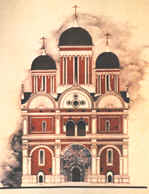
In 1683, the four domestic churches had a common roof crowned by eleven cupolas with magnificent openwork gold crosses. The impediment and the cupola drums are decorated with multi-colored tiles. This splendid gilded roof with eleven domes is visible from Cathedral Square to the west of the Church of the Deposition of the Robe.
|
|