|
|
Among all gems of the Kremlin architectural ensemble the Facets Palace holds special place. Its very appearance is quite extraordinary: it is a simple rectangular building the façade of which is covered by small-sized projecting tetrahedrons cut in white stone; amongst these are the windows framed with carved white-stone cornices and slender colonnades. The building produces an unforgettable impression.
It was built as the throne hall for the Grand Prince Ivan III. The history of this hall is rather interesting.
In 1462, Ivan III ascended to the throne proclaiming himself the “Tsar of All Rus”. In 1472, he married the Byzantine princess Zoe Sophia Palaeologus. Perhaps it was then that the Italian architects Marco Ruffo and Pietro Antonio Solario came to Moscow. At that time, large-scale construction was under way in Moscow. In 1485, construction of a new palace for the tsar commenced. It was finished in 1508 after the death of Ivan III. His son, Prince Vassily III, became the first owner of the palace. The palace was rebuilt many times from the second half of the 16th to the 17th century- under Ivan the Terrible, Boris Godunov and the first tsars of the Romanov dynasty. Only the gala throne hall – the Facets Palace – has been preserved to our days out of the sumptuous monumental building of the 15th century. Its main façade looks out over Cathedral Square, which in olden days witnessed solemn coronation processions, religious ceremonies, and receptions of foreign ambassadors. The Façade of the Palace is faced with white stone slabs rusticated into four facets, hence the name of the Palace – the Facets (Faceted) Palace. Originally, the Palace had a high pyramidal canopy roof made of copper, which can be seen in the miniature of the book “Concerning the Election to the Highest Throne of the Great Russian Tsardom of his high Majesty, Tsar and Grand Prince Mikhail Fyodorovich, the Sovereign of All Great Russia”.
Over the following three hundred years, the appearance of the Palace changed several times: after the 1684 fire in the Kremlin the high roof was replaced by a lower iron one; the old windows were widened and lavishly decorated in the baroque style: the windows were framed in carved white stone and the round colonnades decorated with a carved ornament in the shape of the twining vine, between the bases of the colonnades are the lions carved in relief.
At one time the gala Red Porch with a flight of steps leading to the Holy Vestibule used to adjoin the Facets Palace. The vestibule served as a means of access to the Facets Palace. Here the visitors waited to be received by the tsar. The six carved white-stone portals which are lavishly decorated with ornamental carving and gold and sumptuous colorful murals dedicated to religious and historical themes are sure to impress. The oldest frescoes had been lost but were repainted by Fyodor Zavyalov in 1847.
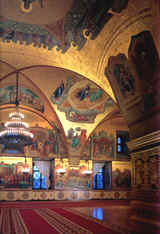
The Throne Hall, the largest one at that time (500 square meters in area, 9 meters high) has a cross vaulted ceiling propped up by a massive pillar in the middle lavishly decorated with white-stone gilded ornaments representing dolphins, birds and beasts. The portal of the Facets Palace is just as lavishly decorated with stylized floral ornament and mythological beasts.
The Palace's interior decoration has undergone substantial changes over the last five hundred years. It was first painted at the end of the 16th century under Tsar Fyodor Ivanovich, the last tsar of the Ryurik dynasty. By the end of the 17th century the old frescoes were in a poor state, so they were cut off, and the walls upholstered in red cloth. In 1881, it was decided to have the Facets Palace painted anew for the date of coronation of Emperor Alexander II; this was to be done according to descriptions of the original 16th century themes and compositions as compiled by the well-known painter Simon Ushakov back in 1676. In 1882, the Belousov brothers, painters from the village of Palekh, repainted the walls in the traditional style of 16th century icon painting. They painted their frescoes on old brickwork. In thirteen circles and semi-circles on the vaults and sloping walls they placed biblical compositions on the creation of the world. On the vaulted ceilings, as if passing over from the world of heaven to that of earth, the artists portrayed prophets, forefathers and evangelists with scrolls in their hands. On the walls, in keeping with tradition, they painted themes from the Bible and Russian history.
The paintings on the east wall are of special significance. The point is that the southeast corner was the place where the tsar's throne once stood. The east wall and a part of the south wall which served as background for the tsar sitting on the throne, are painted with subjects based on “The Tale of the Brothers of Vladimir”. These compositions are pictorial representations of historical continuity, and consequently, the legality of the power of Moscow princes. This idea should have underlain the efforts to unify separate principalities each upholding their independence into an integral state. The first Ryurik princes who allegedly descended from the family of the Roman Empror Augustus and the Kievan prince Vladimir, under whom Rus adopted Christianity back in 988, figure in one of these compositions. The painting on the south wall represents the presentation of the tsar’s regalia to Prince Vladimir Monomach. Tsar Fyodor (son of Ivan the Terrible) and Boris Godunov are also depicted there. On the sloping walls at the windows there are twenty-four stylized portaits of Russia’s rulers who brought fame to their country by their glorious deeds.
The subjects of the frescoes of the Facets Palace seem to invite one to draw a parallel between the biblical stories and events of the Russian history. For instance, the rise to power of the Russian Tsar Boris Godunov and the parable about Joseph the Beautiful from the Old Testament. Opposite the tsar’s place, on the west wall of the palace, there are scenes from the didactic parable about the just and adjust judges, placed there as a reminder to the tsar of his duty.
The Gala Hall was used for official and solemn events: it was here that the state Councils were convened and the Boyars, Duma (Council) held its sessions, foreign ambassadors were received and heirs to the throne named. Hence, the hall saw many significant events in Russian history. Feasts and receptions were organized with especial luxury. The boyars, dressed in luxurious velvet and brocade garments, with tall sable hats on their heads, were sitting on the benches placed along the walls; in special cases standing around the central pillar gala utensils and vessels were displayed.
|
|