|
|
The Tsar Cannon and the Tsar Bell are displayed in Ivan’s Square. They are fine examples of monumental artistic casting.
The Tsar Cannon shows the high level of the Russian casting art in the 16th century. It was cast of bronze by Andrei Chokhov at Moscow’s Cannon Yard in 1586, during the rule of Tsar Fyodor Ivanovich, Ivan the Great’s son. The Cannon weighs 40 tons and is 5m 34cm long, its caliber is 890mm. It is the world’s biggest cannon as regards its caliber. Hence it got its name:” The Tsar Cannon”. It was meant to be used for defending the Moscow Kremlin and was positioned near the Spassky Gate. However, it has never been fired. There are ornament and relief inscriptions on the barrel, which tell its history, and there is also a cast relief image of Tsar Fyodor Ivanovich on horse holding scepter in his hand.
An iron decorative gun carriage designed for the Tsar Cannon by the architect A.P.Bryullov was cast in 1835 at Berd’s work in St. Petersburg. The cannon balls, which are beside it, are purely decorative, and each weighs one ton.
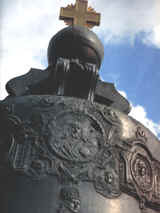
The famous Tsar Bell is a unique monument of the casting art of the 18th century. It is at the root of the Belfry of Ivan the Great. It was cast by the Moscow founder Ivan Motorin and his son Mikhail in the Kremlin in 1733-1735. The Russian craftsmen V.Kobelev, N.Galkin, N.Kokhtev and N.Serebryakov adorned the bell with relief ornament, images and inscriptions. The figures of Empress Anna Ivanovna and Tsar Alexei Mikhailovich are in the foreground. Inscriptions telling the bell’s history are in decorative cartouches with baroque volutes and angels. During the fire of 1737 the Tsar Bell was in the foundry pit. The red-hot metal cracked because of uneven cooling when they extinguished the fire. A piece weighing 11.5 tons broke off the bell. The bell remained in the pit for about 100 years after that. It was not until 1836 that it was raised and placed on a pedestal after a plan specially designed by the architect A.A.Montferrand. The Tsar Bell is the largest in the world; it weighs over 200 tons, is 6.14m tall and is 6.6m in diameter.
The Bell was restored in 1980. The paint and drying oil layers were removed and the pedestal was strengthened.
|
|