|
|
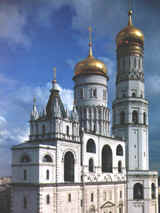
The Kremlin architectural complex is dominated by the Belfry of Ivan the Great. Together with the adjoining bell tower and the Filaret Tower it forms the ensemble of the east part of Cathedral Square.
The Belfry was built by the architect Bono Friazin in 1505-1508 and originally consisted of two lower tiers and part of a third tier. It was 60m tall. It was named “Ivan” after St. John the Climacus to whom the church in the first tier was consecrated, and “The Great”- because of its unusual height. It used to be the Kremlin’s watchtower in olden times because of its view of 25-30 km.
In 1600, by order of Tsar Boris Godunov, the belfry was brought up to the height of 81m. An inscription in golden letters under the cupola testifies to this fact.
In 1532-1543 the architect Petroch the younger built a church with a bell tower on the north face of the belfry. In 1624 the Filaret tower was added to the second building. All these structures joined to create an integral architectural complex.
The Bell Tower and the Filaret Tower were blown up by the retreating Napoleonic army in 1812. The Belfry of Ivan the Great was not destroyed but it cracked. It was saved by the craftsmanship of its builders who had erected an exceptionally solid structure.
In 1819 the Bell Tower and the Filaret Tower were restored by the architect D.I.Gilardi.
There are several staircases leading to the Belfry’s upper sections. First, an inner stone staircase of 83 steps, then a spiral staircase of 149 steps and, lastly, a spiral metal staircase (97 steps), which leads up to the cupola.
There are 21 16th-19th cc. Bells in the belfry and the bell tower. These bells are both ancient musical instruments and highly artistic examples of monumental casting associated with the names of Russian founders such as Fyodor and Ivan Motorin, Andrei Chokhov, Filip Andreyev and Vassily and Yakov Leontyev.
The contemporaries named the most popular bells, for instance there are bells called “Novi”, “Reut” and “Uspensky”. The Uspensky bell is the largest, it weighs 70 tons.
The Square immediately behind the Belfry of Ivan the Great has been called Ivanovsky (Ivan’s) Square since olden times. This is where the buildings of the prikazes (state judicial departments) used to stand. Therefore, the tsar’s decrees were announced here. The dyaks (the prikaz’s officials) shouted very loudly so that they could be heard throughout the square. Since then there has been a saying in Russia: “To scream at the top of your lungs so that all of Ivanovsky could hear”.
There is an exhibition hall on the first floor of the bell tower where the works of art from the Moscow Kremlin collections are on display.
|
|