|
|
The architectural ensemble of Cathedral Square which was being formed in the 15th-16th centuries is closed on the north side by the building of the Patriarch’s Palace. Today, it houses the Museum of Applied Art and Life-Style of 17th-century Russia.
From the first decades of the 14th century, The Metropolitan’s residence was already on this site. The earliest brick building was erected here back in 1450: “Metropolitan Jonah laid the foundations of a stone chamber in his courtyard”, says the chronicle. Over several centuries that have passed since then, the metropolitan’s residence with all its structures was damaged by fire many times and then rebuilt.
An important stage in the history of the Patriarch’s Palace is associated with the name of the all-powerful Patriarch’s Nikon (1605-1681). In 1653, he started the grandiose rebuilding of his residence. He summoned the best architects, painters, goldsmiths and stone-carvers to do the job. In two years the palace of the High Priest was not inferior to the tsar’s residence as regards its size, architectural aspect and exuberant decoration. This was consistent with the Patriarch’s political credo declaring the superiority of “Priesthood over Tsardom”.
The palace and the domestic church of the Twelve Apostles adjoining it make an integral architectural set. The church stands on high through arcades. The facade is decorated on all sides by two rows of small arches. The white-stone decoration of the walls of the Patriarch’s Palace is in perfect harmony with the décor of the other architectural monuments in Cathedral Square.
The Palace’s numerous halls are connected by vestibules and passages. In keeping with tradition, the ground floor was used for household needs and services; gala halls (chambers) and the domestic church were on the first floor, and the patriarch’s living apartments on the second.
In 1721, the palace became the seat of the Moscow Holy Synod.
The palace was repeatedly rebuilt in the 18th-19th centuries and the medieval decoration of its interior has not been preserved. The museum, which has been opened here, is based on the Moscow Kremlin collection. It contains objects, which characterize the 17th-century life-style of the top layers of Russian society (both secular and religious).
The exhibition in the Small Vestibule (Inner Porch) shows how the metropolitan’s, and later the patriarch’s, residence appeared in the territory of the Kremlin.
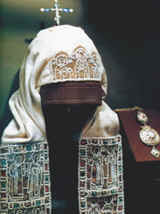
In the Gala Vestibule, religious and every-day articles which used to belong to the heads of the Russian church in the 17th century are on display: Patriarch Nikon’s sakkos, domestic caftan and Klobuk (headgear); Patriarch Philaret’s bratina (loving-cup), the bratina and the plate belonging to Patriarch Joseph, a silver walking stick adorned with precious stones, etc.
These precious possessions reflect the tendency of the time the attributes of ecclesiastical and secular power vying with each other come closer with regard to the splendor and sumptuousness of their decoration.
The main gala hall of the Patriarch’s Palace was the Krestovy (cross) Chamber. Functionally, it played the same role as the Facets Palace in the Great Kremlin Palace. In this hall the patriarch received the tsar and ambassadors of foreign states; here church councils (Sobors) were held and special banquets too. In 1763, after a stove for making chrism was built here and a wood-carved canopy roof erected over it, the hall was then called the Chrism Chamber.
The huge hall, 230 square meters in area, has no supporting pillars and is remarkable for its new architectural design and the beauty of the interior decoration. The floor of the chamber was first laid with colorful tiles and the windowpanes were of multicolored mica. Contemporaries said, “The hall strikes the imagination, there is no equal to it in the whole tsar’s palace”.
Today, this unique specimen of civil and religious architecture of the mid-17th century houses a museum of applied art and life-style of 17th-century Russia. This occupies the first floor of the building.
This hall contains articles of everyday use which were designed for various purposes: Old Russian household utensils, articles made by silversmiths and goldsmiths from both East and West, jeweler, a collection of table clocks and pocket watches, some items of the tsar’s gala horse tackle and hunting gear, etc.
The exhibits shown here are interesting as the typical examples of works of art and everyday articles of the 17th century. Hence one can acquire a better knowledge of Russia’s material and spiritual culture and its customs and traditions.
The two other rooms of the palace which have retained their old architectural forms give an idea of the décor of rich living apartments of the 17th century. These are rather small rooms with low vaulted ceilings and narrow windows; the windowpanes are of colored mica. Their decoration was usually bright and multicolored: the walls were upholstered in colorful cloth, foreign fabrics, or leather stamped with gold, the floor was upholstered in colorful felt. Multicolor glazed tiles covered the stoves. Icons were given an important place in the interior decoration. They were usually placed in the “front”, or “red”, corner. Examples of traditional furniture are the broad benches covered with colorful cloth, and the big chests in which kitchenware and other household utensils were kept.
With the changes in the traditional “patriarchal” way of life in the second half of the 17th century, the interior of rich houses also altered. As one of the contemporaries aptly said, there “the old and the new met and mixed”. In a single room, alongside traditional Russian furniture, one could find a Dutch dresser and a German cupboard; portraits of Tsar Alexia Mikhailovich and courtier P.I.Potemkin could be seen on the walls next to icons. A study could have a collection of manuscripts and printed books of the 17th century (among them the hand-written ABC book by Karion Istomin, and the book entitled “A Medicine for the Soul”, and the printed Grammer Book and the Gospel), as well as some pieces of furniture.
The interior of rich people’s living apartments has been recreated on the basis of documentary evidence; genuine articles have been used.
The refectory of the Patriarch’s Palace houses a collection of Old Russian decorative and pictorial embroidery. Works of this original art produced by Russian seamstresses and gold embroideresses had different uses; among them were covers for church vessels, the palls for tombs of saints, and pelenas (altar-cloths) for the icons. All of these used to decorate church interiors at one time. Pearl embroidery and precious stones were very popular. A remarkable piece of fine embroidery work is the pelena “The Virgin of Vladimir” from the vestry of the Cathedral of the Assumption. Made by seamstresses of the Tsarina’s Kremlin Workshops, it looks more like an icon in a gold frame studded with pearls and precious stones than a piece of embroidery.
One of the most interesting sections of the said exposition is housed in the Cathedral of the Twelve Apostles. This domestic church of the Russian patriarchs forms part of the architectural complex of the Patriarch’s Palace. The interior of the church has undergone many changes over the past centuries: the windows were widened and the iconostasis repainted. The present-day restores succeeded to a great extent to recreate the 17th- century interior.
The old iconostasis has been lost. The present sumptuous five tier iconostasis made of carved and gilded wood used to belong to a cathedral of the Kremlin’s Ascension convent (now demolished) and it was transferred to the Cathedral of the Twelve Apostles in 1929. The iconostasis has been fully restored. It is executed in the late 17th-century Moscow baroque style and is remarkable for the variety of ornamental motifs and expressiveness. The rich ornamentation includes flowers, fruits and berries. But the favorite motifs are a twining vine, acanthus leaves and a scroll.
Today the church contains a unique collection of 17th-century icons most of which adorned the Kremlin cathedrals. The exhibition is arranged in chronological order which makes it possible to follow one of the most interesting trends in the development of Russian icon-painting in the first half of the 17th century- the so-called “Stroganov” school, and also to get an idea of the work of the court icon-painters in the second half of the 17th century. The Stroganov school icons “elevated the soul” and “pleased the eye”; they were painted for art connoisseurs and possessed special aesthetic qualities. The name of the “Stroganov School” is associated with the patronage of art on the part of the “eminent Stroganov family” who had their own icon-painters’ workshops in the town of Solvychegodsk in the Urals. The period between 1660s to the end of the 17th century saw a departure from the traditional style of Russian icon painting. In such work as “Theodore Stratilatus”, “St. Andrew”. “The Crucifixion” and other icons by the well-known painters of that time such as Simon Ushakov, Fyodor Zubov and Fyodor Rozhnov, some features of new art, later known as “realistic” art, become noticeable, moreover, an apparent interest in life, nature and man makes itself strongly felt.
The exposition of the Museum of Applied Art and life-Style of 17th-century Russia gives an idea of the aesthetic concepts and artistic tastes of Russian society in the 17th century allowing one to feel and understand the uniqueness of the country’s spiritual life at the turning point of its history-the transition from medieval to modern history.
|
|