|
|
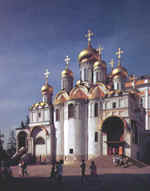
The Cathedral of Annunciation, masterpiece of old Russian architecture, stands on the crest of Borovitsky Hill, in South part of Cathedral Square. It is originally built as the domestic church of grand princes and tsars and part of the tsar's personal quarters. The Cathedral was connected to tsar's palace and Archangel Cathedral by passages. This church was to be used to celebrate various family events, such as weddings and baptisms, name-day celebrations...
The history of Cathedral of Annunciation dates back many centuries. Remains of the old foundation show that a stone church of Annunciation stood on the site at the end of 14th century. In 1416, second, bigger cathedral was built on its extant basement. The present tall and slender Cathedral was erected in 1484-1489, by Pscov masons, to replace the dilapidated cathedral of the early 15th century. Originally, the cathedral had three domes and was surrounded by galleries on all sides.
In the second half of 16th century, during the reign of Ivan the Terrible, the cathedral was rebuilt and 4 small single-domed side-chapels, were erected on the vaulted gallery roofs; two more domes were also added on the rear side of cathedral. Cathedral, now, had 9 domes, which, as with the roof, were gilded. The porch was also rebuilt, taller and in white stone, and flight of steps was added to it on South side.
The rebuilding of the porch was associated with the 4th marriage of Tsar Ivan the Terrible, who was put under penance by the Church. Therefore, by church rules, he could not attend services in the church, but had to stand in the porch. The extant porch is actually part of the 1489 cathedral. One could go from the tsar's palace to the treasury standing between Archangel Cathedral and Cathedral of Annunciation, then to Archangel Cathedral and go down to the palace's gardens.
In 16th century, Italian stone-carvers renovated the portals of cathedral, giving them their present appearance. Tall doors were covered with copper plate inlaid with gold and decorated with themes from Bible. The refined beauty of Golden Gates seem to invite the visitor in to view cathedral's resplendent interior. The floor of cathedral is made out of agate-colored jasper of various shades and is also impressive.
Frescoes on the cathedral walls were first mentioned by chroniclers, in 1508. The fire of 1547, about which sorrowful records were left in Russian chronicles, ruined all wall paintings. Cathedral was painted again in 1547-1551. During the period from 17th to 19th centuries, the frescoes were painted over many time.
Cathedral of Annunciation is one of very few old Russian monuments containing almost intact monumental painting of 16th century. These genuine paintings are the work of a group of Russian painters.
On the vaulted gallery ceiling is "The Tree of Jesus", which depicts the biblical story of the origin of Christ and show both his forefathers and his disciples, the apostles; here, also, are portraits of philosophers, historians and poets of the antique world, as Homer, Virgil, Plato and Plutarch, seen as the forerunner of Christ. The composition symbolizes the prehistory and history of Christianity.
The central part of cathedral is painted mainly with frescoes on the themes from "Apocalypse", one of early Christian works, describing the end of mankind on earth, The Last Judgment, and finally, the eternal triumph of good and justice.
The pillars of cathedral are decorated with stylized portraits of Byzantine emperor Constantine, who made Christianity the state religion in 4th century, of his mother Helen, and also of Kievan Princess Olga, and Prince Vladimir, who initiated Christianity in Russia. Pillars opposite them are painted with martyr-warriors St. George and Dmitry Solunsky, and also the first Russian saints, princes Boris and Gleb. The group of righteous men also includes Russian princes, as Vladimir Monomach, Alexander Nevsky, Ivan Kalita and Dmitry Donskoy, with his son Vassily.
The combination of frescoes in Cathedral of Annunciation reflects the state doctrine proclaiming Moscow "Third Rome" and supporting Moscow Tsar's claim to be directly connected to Byzantine emperors and Roman Emperor Augustus. Their portraits painted on the pillars of the cathedral emphasized the direct inheritance of power by Moscow grand princes from the Kievan grand princes and Byzantine emperors.
The interior of old Russian church is usually adorned with multi-tier iconostasis. The iconostasis of the Cathedral of Annunciation, remarkable for its artistic merit, contains icons belonging to different ages, from 14th to 18th centuries, and to different artists.
The icons of deisus tier, which is the most significant of all, were painted in the late 14th century (the name is taken from Greek word "deesis", meaning "prayer"). The plasticity of forms, richness of colors and peculiarities of technique, make it possible to ascribe these icons to the hand of outstanding artist Theophanus the Greek. Above the deisus tier depicting Christ's worldly life and his miracles. The icons were painted in the early 15th century. In 1918-1919, those two tiers were first cleaned of later additions and restored to their original state.
In the mid-16th century, icons of prophet tier were painted. The uppermost tier, of the forefathers, consists of small icons shaped as kokoshniks (traditional head-dress of Russian women), dating to 16th and 19th centuries. The icons of the lower, local saints' tier, date from 14th to the early 18th centuries.
Cathedral of Annunciation is built of white stone and is noted for its picturesque architectural forms, its shining gilded cupolas and roof and its resplendent decor. The slim apses, the Pyramidal arrangements of the cupolas and kokoshnik-shaped gables lend the cathedral a look of lightness and elegance.
|
|