|
|
The history of Moscow and the Kremlin goes back to olden times. The first written record of Moscow dates back to 1147, to the reign of Grand Prince of Kiev Yuri, Vladimir Monomach’s son. He was nicknamed “Dolgoruky” (Long-armed), i.e., one reaching out for other principalities, for his unification policy. Yuri Dolgoruky is considered to be the founder of Moscow and in commemoration of this an equestrian statue by the sculptor S.M. Orlov was erected in Tverskaya Street in 1954.
One of the most remarkable exhibits of the Kremlin museums connected with the genealogy of Russian princes is the Cap of Monomach, the Russian tsars’ inherited crown. It even became proverbial. There is a saying: “How heavy you are, the Cap of Monomach!” meaning the heavy burden of responsibility.
Since time immemorial the Moscow Kremlin has been the center of Russian statehood, the residence of Russian tsars and hierarchs of the Russian Orthodox Church.
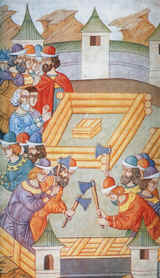
Under Dmitry Donskoy in 1367-1368 the white-stone walls and towers of the Kremlin were erected and Moscow began to be called “white-stone”. In 1485-1495 the Kremlin was totally rebuilt. It was then the first brick buildings appeared there and it largely acquired its present appearance and dimensions.
At the beginning of the 18th century, Peter I transferred the capital of Russia to St. Petersburg, however, according to tradition, the Russian tsars were coroneted in Moscow.
In 1917 the Soviet government transferred the Russian capital back to Moscow. The Kremlin became the seat of the highest state bodies, a sort of preserve, where only in 1955 that its unique museums have again become accessible to all. Church services have recently been resumed in the old cathedrals and the Kremlin bells, which have been silent for over 70 years, have come to life.
The Kremlin has been the residence of the President of the Russian Federation and his Administration since 1992.
The Kremlin has been and remains a unique monument of Russian culture and a symbol of Russian statehood.
more details...
|
|