|
|
On a hill overlooking Turkish capital of Ankara, is the monument to the man without whom this land of dramatic physical contrasts would have been reduced to little more than a patch of steppe land. General Mustafa Kemal roused a people already exhausted by Ottoman defeat in First World War, drove the invading forces into the sea, and won back for Turks their homeland.
Taking the name "Ataturk" of "Father of Turks", Mustafa Kemal founded the modern democratic Republic of Turkey, based on Western laws. It was Ataturk who made the strategically placed Ankara Turkey's Capital, and the city is monument to his vision of modern Westernized state.
Looking back over his country's 8000 years heritage of civilization, Ataturk said: "The nation is ready and resolved to advance inhaling and undaunted on the path of civilization".
Even around Ankara, this path of civilization stretches back long way; to Hittites, proud and warlike people, who ruled an empire from Black Sea to Palestine in 2nd Millennium BC, and Phrygians, Thracian people who dominated Anatolian plateau in 1st millennium BC.
Hittite capital to Hattusas (now called Bogazkale) lies 200 km to North-east of Ankara. The craggy hill was ringed by double walls and its gates were guarded by lion statues. Close to Hattusas is Hittite open air sanctuary of Yazilikaya, and also nearby is Hittite city of Alacahoyuk.
To South-west of Ankara, near Polatli, is the site of Phrygian capital of Gordian, where Alexander the Great cut the famous Gordian knot that gave him the key to Asia. Also at Gordian is the great earth tumulus of King Midas, famed in the legend of Golden Touch.
Mirroring all Anatolia's civilizations is Ankara's Archeological Museum, with its unique collection of proto-Hittite sun discs and stag cult figures, Hittite relieves and Phrygian metalwork.
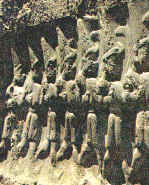
Yazilikaya
|
|