|
|
Gentle Aegean breezes blow over the sapphire gulfs and ruffle the silver-green leaves of olive trees along this coast that witnessed the dawn of Western civilization.
Here stands Homer's Troy, one of the most evocative sites of antiquity, recalling the epic struggle of Iliad. Of the settlement mound's nine levels, the sixth is presumed to be Homer's Troy.
To the South lie the ruins of great city of Pergamon, center of learning and arts, which possessed one of the greatest libraries of antiquity.
Not far from Pergamon's Acropolis are the ruins of Asclepieion, one of the foremost medical centers of Classical times.
In the center of Turkey's Aegean coast lie in the region of ancient Ionia, with ruins of Ephesus, Priene, Miletos and Didyma, all reflecting the timeless grace of Ionian architecture.
Few cities can claim that their names are so closely linked with mankind's intellectual advancement as these cities of Western Anatolia. For it was here that thinking was first freed from superstition, here that the foundation of experimental science were laid, and here that "man became the measure of all things".
Chief among these Ionian cities was Ephesus, Roman capital of Asia, of which St. Paul asked: "Is there a greater city?" Along Ephesus' Arcadian Way, Mark Anthony and Cleopatra once rode in procession, in the great theatre St. Paul preached against the Ephesians' goddess Diana, and in little house outside the city, which can still be seen, Virgin Mary spent her last days.
The other Ionian city also had important historical roles: Priene's chessboard layout is the oldest example of city planning, Miletos gave its alphabet to the rest of Classical world, and Didyma's Temple of Apollo with its famous oracle was one of the most sacred places of antiquity.
Contrasting with the tranquility of these ancient sites in the gaiety of the seaside resorts. The capital of Turkish Aegean Izmir, the birth-place of Homer. This modern city with palm lined avenues, possesses one of the five finest natural harbors on Mediterranean. Overlooking the city is Kadifekale or Velvet Castle, originally built by one of Alexander the Great Generals.
To the North of Izmir is the resort of Ayvalik, near which is the high escarpment known as "Seytan Sofrasi" or "Satan's Table", from which there is splendid view of Aegean coast and islands.
Further to the South is the little resort town of Foca, whose inhabitants founded such towns as Marseilles and Nice.
To the West of Izmir is the resort of "Cesme", famous for its crystal sea and thermal springs, and to the South is the attractive resort of "Kusadasi", surrounded by many sandy bays.
in South-West Aegean are the resorts of Bodrum, Marmaris and Fethiye. Bodrum, the ancient Halicarnassus, is dominated by a castle built by Crusader Knights of St. John, and today the little town is the special haunt of young people. It was here that one of Seven Wonders of the World, Tomb of Mausolos, once stood (another of Seven Wonders was Temple of Diana at Ephesus).
Marmaris is in deep fjord like inlet, where the pine woods come right down to the shore. Fethiye also lies in deep bay, in the hills above which are intriguing Lycian rock tombs.
Even if nothing but the foundations of Wonders of the World can now be seen, the natural wonder of the calcified waterfall of Pamukkale (near Denizli) compensates for this. Thermal spring waters, laden with calcium carbonate running off the plateau's edge, have formed this sparkling white petrified cascade of basins ringed by stalactites. Thermal waters have been used since Roman times for their therapeutic powers, and behind waterfall lie the ruins of Roman city of Hierapolis.
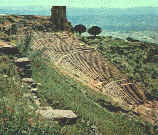
Pergamon
|
|