|
|
Singapore's three major racial groups, Chinese, Malays and Indians, have over the years developed little pockets of architecture, customs and colorful festivals that express their proud heritage. Take a stroll through the following areas and be enthralled by their distinctive characters.
Chinatown
Chinatown's history dates back to 1819, when Sir Stamford Raffles founded Singapore. Chinese, who compose the largest group, were given the entire area Southwest of Singapore River.
Hokkiens concentrated their trading efforts along Telok Ayer Street, China Street and Chulia Street.
Teochews continued their farmer-fisherman tradition, occupying Circular Road and South Bridge Road (near the present day Boat Quay).
Cantonese, traditionally goldsmiths, tailors and restaurateurs, constructed their shop houses along Temple Street, Pagoda Street and Mosque Street.
Today, Chinatown is the venue of lovingly conserved buildings, century-old beliefs and intriguing contrasts. For instance, Singapore's oldest Hindu temple is right smack in the middle of Chinatown.
A new feature in Chinatown is Speaker's Corner. Located in Hong Lim Park, the Speaker's Corner provides Singaporeans with a venue where they can speak freely outdoors in public on almost any issue. Drop by the park between 7 AM and 7 PM daily and watch Singaporeans wax lyrical on issues close to their hearts.
Little India
Little India stretches from Rochor Canal to Lavendar Street. While early Indians resided in Chulia Street near Chinatown, most of them resettled to the present Little India due to the introduction of cattle rearing on the fertile land of Rochor River.
Immigrants from Madras, Calcutta and Malaya joined them soon after. Today, Little India is the center of local Indian Community. The best time to visit Little India is early morning, when one can enjoy the spicy aromas, colorful traditions, strains of sitar music and colorful garlands.
Geylang Serai
Malays had been living in Singapore long before Chinese or Indians, and Geylang became their enclave in 1840s, after British dispersed Malay floating village in the mouth of Singapore River.
Highlights to look out for in this area are Malay Village, Geylang Serai Market, Chinese Baroque terrace houses and Malay bungalows complete with wood carving and European tiles.
Kampong Glam
It is named after Glam tree, which grew in the area. Medicinal oil was extracted from the tree and its bark used by Buginese and Malay to caulk their ships. The area was the historic seat of Malay Royalty in Singapore.
Today, the area sits comfortably between progressive terrace houses and old shop houses. Highlights include the old Malay Cemetery, Sultan Mosque, Rumah Panjang and Arab Street, famed for its silk and basketry.
Singapore River
Singapore River was the lifeline of Singapore, where first immigrants eked out a meager living and saw Singapore transform from an obscure fishing village to a great seaport. And into a modern metropolis famous for its skyscrapers, Merlion and "gastro-manis".
Highlights on its banks include Boat Quay, Clarke Quay, Merlion Park, Parliament House, Asian Civilizations Museum, Tan Si Chong Su Temple and Omar Kampong Melaka Mosque.
URA Gallery
One can learn about Singapore's urban development history in URA Gallery, where the key attraction is a huge scale model of the city that also sets out its future development plan. It is also home to 48 stunning displays, interactive touch screens and exciting 3-D animations.
It is located in URA Center, 45 Maxwell Road, Singapore 069118
Tel.: 321 8321
Opening hours:
Mon-Fri: 9-16:30
Sat: 9-12:30
Closed on Sunday and public holidays.
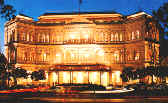
Raffles Hotel
|
|