|
|
History of Yazd Province: Timurid era
In 1386 AD, the founder of Gourkani dynasty, Amir Timur (Timur the Lane), while carrying on his three-year invasion of Iran, ended Mozaffar's Family rule in Yazd and entrusted the city's government to one of his own agents.
Actually, the way Amir Timur treated Yazd was unprecedented throughout his rule in Iran. He instructed the appointed ruler to be lenient towards the people of Yazd, exempt them from a two-year tax, repaired and built the city's rampart and reconstructed the governor's palace known as Mobarakeh Castle of Narain Castle in the best possible way. Timur the Lane was aware that massacring people would also destroy industries uniquely belonging to Yazd.
His son, Shahrokh, after triumphing over his rivals, conferred Yazd's government on Amir Jalaleddin, son of Chaqmaq. He, too, treated the people in a tolerant way and left so many vestiges of his rule in Yazd.
Grand Mosque's tile works, Amir Chaqmaq Square and Mosque and the old prayer compounds all belong to that era. Also, numerous schools and libraries such as Sarpolok's Qotbieh School and Library, Darul School, Yousuf Chehr School and Library, Mardhouk's Asilieh School and Library and Bavardieh Library were built in the same period and many authors, scholars and historians such as Sharafoddin Ali Yazdi were educated and trained in those seats of learning. With the emergence of Qara Qoyunlou and Aq Qoyunlou Turkmen, Yazd fell out of Timur the Lane's domain and was ruled by Turkmen governors successively; but the city saw a period of decline under them.
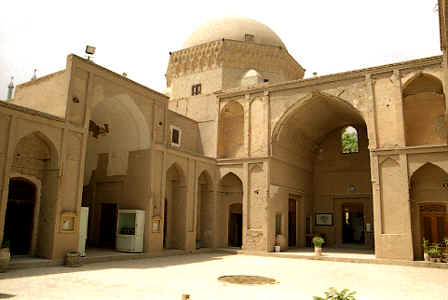
Alexandre Prison (Sekandar Prison): Yazd
Photo by: Masoud Soheili
|
|