|
|
Isfahan, province of great antiquity, known as exponent of Iranian art and history, is located in the central part of Iran and covers an area of 105,263 Sq. km. It is surrounded by Yazd and Khorasan from East, Markazi from North, Lorestan, Khuzistan, Chahar Mahal Bakhtiari and Kohkiluyeh from West and Fars from South.
Isfahan consists of plains as well as mountainous areas and has three kinds of climates: Dry, semi-dry and semi-humid. The most parts of the province enjoy temperate climate. Lofty snow-clad mountains as Dena, Karkas, Shahan-kouh and Alvand lie in Isfahan province. The largest river in the central plateau is (was!) Zayandeh-roud, which passes through Isfahan province; also there are other rivers as Morqab, Gandoman, and Anar-bar.
Different climates have created animal life in rich variety. Agriculture and husbandry are of high importance in Isfahan. This province has many large and small industries, including the heavy industries of ironworks and steelworks. It is rich in natural resources, among which there are mines of coil, iron, zinc and lead. "Mouteh" (220,000 hectares), "Qameshlou" (37,000 Hectares) and "Kolah Qazi" (48,000 Hectares) are three protected regions for wildlife in Isfahan.
Between the majority of Muslim people and Persian language, are minority of Armenian and Hebrew and also Turkish language people.
Old city of Isfahan, with various historical buildings and monuments, is the capital of Isfahan province. Other cities are:
Aredstan, Khansar, Khomeini-shahr, Samirom, Faridan, Fereidoun-shahr, Kashan, Falavarjan, Shahreza, Golpayegan, Lanjan, Nain, Najaf-abad and Natanz. These cities are linked with roads and some highways and city of Isfahan has also airport.
Isfahan is famous for its delicate and beautiful crafts, such as inlaid, engraving, wood work, filigree work, miniature and carpet. Local sweets, especially "Gaz" (confectionary made from manna) are very delicious and well-known.
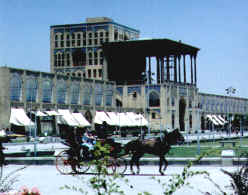
Aali Ghapou
|
|