|
Sari, it is said, was
born on the loom of a fanciful weaver. He dreamed of
woman, the shimmer of her tears, the drape of her tumbling
hair, the colors of her many moods, the softness of her
touch. All these he wove together. He could not stop. He
wove for many yards. And when he has done, the story goes,
he sat back and smiled.

Over the centuries there have been changes. Today, new
styles and textures have been created. New cotton weaves,
the splendor of silk, flamboyant satin, brocades supple
and dazzling.
More than that, Sari style and its range of fabrics have
gone beyond India and entered the universe of
international fashion.
The world's most graceful garment for women is simply a
stretch of cloth six yards long. In India, it makes Sari.
Elsewhere, it can be tailored into every fashion ever
created by a designer.
Saris come in many famous styles. Each is so individual,
it can be identified by name. Each differs from the others
in fiber, weave, pattern, texture and technique. Here are
some styles that offer a breath-taking choice:
Cottons for day wear. Woven, printed or embroidered;
colors light or gay.
Chanderi: Printed cotton Saris from Sanganer, Rajestan
"Tie-and-Dye" (Bandhani and Laherias), "Ikat
Tie-and-Dye" weaves (from Orissa and Pochampalli) and
Embroidered Chikan Saris (from Lucknow).
Cottons for Summer evening, ornamented with gold and
silver thread. Airy and opulent.
Chanderi, Gadwal, Venkatagiri: Khari prints, from Sanganer
Light Silks for elegance that's practical and informal.
Muga, Tussar and Tabby silks, Batik prints, printed silk
from Bombay, Kashmir and Murshidabad
Rich Silks, for festive and formal wear, the great weaves
with magnificence both restrained and unashamed
Banaras Brocade (gold, silver, silk)
Banaras Tissues, Bangalore, Kanchipuram, Tanjore Ikat
weaves (Patola and Pochampalli)
How to wear Sari?
Sari is worn with a Choli, a short close-fitting blouse,
usually made from the same fabric as Sari. Under Sari, is
a waist-to-ankle petticoat tied with a drawstring.
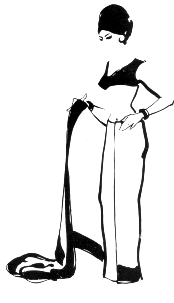
1- Hold Sari with its right-hand edge hanging down in
front of right hip. Keeping lower edge of Sari at ground
level, tuck upper edge firmly into petticoat. Complete
first circle of Sari around you.
2- Make seven to ten knife pleats, each about 5 inches
wide. Hold all pleats up together, so that they fall
straight and evenly. Tuck their tops into petticoat, with
lower edge, just off the ground.
3- Take the rest of Sari around left and right hips. Don't
tuck into petticoat this time.
4- Drape this bit across the bosom, and let it fall over
and behind left shoulder. Use a pin to prevent this part
of Sari, or Pallav slipping off. Pallav (decorated and
piece) can also be brought around and over the right
shoulder to drape in front and reveal its full beauty.
|