|
|
In India, all religions enjoy full equality and followers of each faith celebrate their festivals with traditional gaiety. Many of Hindu holidays are linked with the harvest. For the people, whose mainstay has been agriculture, every change of season is celebrated in song and dance. Others are in honor of mythological deities or are entirely religious involving fasts and prayers.
Dussehra
Dussehra, which usually falls in October, could be seen at its best in Delhi, Kulu Valley and Mysore. This famous festival celebrates the victory of good over evil as depicted in the epic Ramayana, where the godly Rama, the hero, rescues his wife, Sita, from the demon Ravana, by killing him and defeating his army. In Delhi, the nine-day celebrations during which scenes from the story are enacted daily, are climaxed by the burning of giant effigies of demons, made of bamboo and papier mache and stuffed with crackers.
Kulu
In Kulu, people celebrate Dussehra as an Autumn festival. A great fair is held to which the gods from all over the valley are brought in gaily decorated palanquins. In Mysore city, which has been the traditional seat of ancient ruling dynasty, Dussehra is ten-day festival. Public buildings are illuminated.
Diwali
Diwali, following soon after Dussehra is one of the most enchanting expression of popular rejoicing. People outline their houses, gardens and gates with little earthen lamps or candles and whole cities are transformed into fairyland of lights. Diwali is also the time for family reunions. Sweets and greetings are exchanged and the night sky is alight with fireworks.
Republic Day
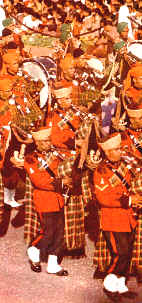
To the many festivals, ancient and traditional, has been added a modern one, Republic Day on January 26. Its celebrations are particularly spectacular in New Delhi. A magnificent parade is held in which President of India takes the salute.
After the armed forces march past the saluting base, come many decorated floats contributed by the different States of India and folk dancers drawn from the far-flung regions of the country. The festivity is marked by illuminations of public buildings, folk dance ensembles and gathering of poets and composers.
It comes to an end three days later with spectacular Beating Retreat, in which massed bands of the three forced take part.
|
|