|
|
No Devine gift, no dainty have been so respected before Iranian people, such as "Bread" and "Salt" and no grace has taken root so deep in their culture.
This respect is not only because these two are signs of blessing, but also a lot of believes and faiths are in the background of those materials.
Notwithstanding the separate meaning and application of those two words, these always go together and sometimes are used as synonyms.
A religious halo has encircled believed connected with bread and salt. These believes and specialties obtained from those words has created many hand woven.
First, size and use of tribal “NAMAKDAN” (salt container) should be discussed. Size and dimension of salt container, having a body and a pharynx, is somehow in relation with tribal prayer rugs and specially Baluch prayer rugs.
Design and relation of these prayer rugs, is woven according to human body; one ground in connection to body and one pharynx in connection with the head (or place, where prayer’s head is set on the ground for prostration). Head design is narrow, like neck. This scheme is to get away from portraits, which is avoided in Islamic Art.
Prayer kilim, with a ground of camel wool and soil color, woven as Namakdan, could be a bridge between feature of Namakdan and prayer rug.
This prayer rug has a surface for prayer; its body is a place for standing and sitting and its pharynx has enough room for putting forehead on prayer seal.
In this respect we don’t mean to say, that Namakdan has been used as prayer rug, but it is a symbol of human body and it has deep idea behind tribal dining cloth.
Revealing those ideas, needs knowing Iranian morals, which expresses ascourtsy, humility, contentment and pauperism, with deep root in Iranian culture. In this culture, poverty and contentment had higher grade than wealth and mundane ornaments; on the basis of those definitions, tribal dining cloth is woven at extreme simplicity and minimum design.
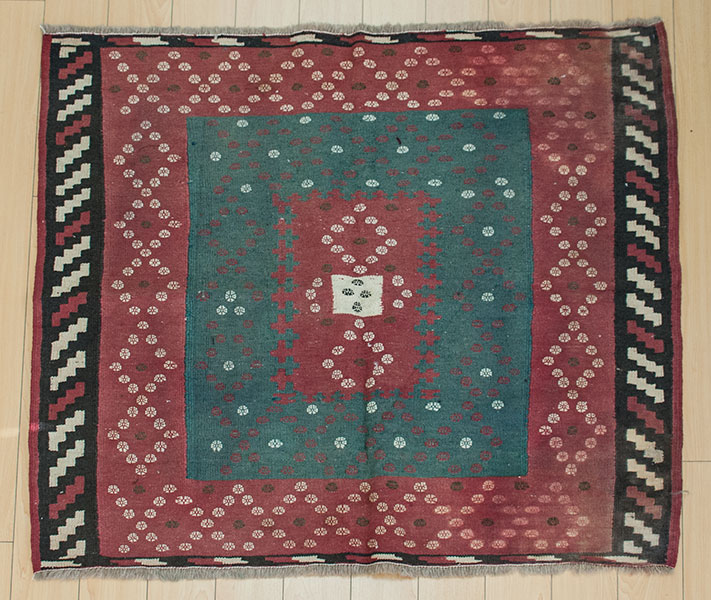
Comparison between aristocratic and tribal dining clothes (SOFREH), shows that everything of these two are in contrast; while aristocratic dining cloth are made of expensive materials, gold embroidery painted and depicted, in other hand, tribal dining cloth is made of wool with plain design.
Those clothes mostly prepared from un-dyed, raw wool and with soil color, to have less cost and also to be near to soil, and if a narrow margin was turned around this soil ground, in addition to carpet weaving tradition, is to indicate the limits of Sofreh (dining cloth), where those divine gifts are served and to prevent stepping or exceeding to this respected limit.
Application of un-dyed soil color wool for dining cloth and non application of dye and image for dining cloth might be in relation to mystical thoughts. Lack of image and color in these dining clothes, means also lack of food over the cloth, as an objection to the riches dining cloth, in which variety of foods are served. A little color and design in tribal dining cloth is due to the taste of women weavers of clan, having tendency to colors, finesse and beauty.
|
|