|
|
People of Indo-Pakistan subcontinent have always had deep appreciation of all the various art forms, pictorial art ranking as one of Indo-Pakistan's foremost arts. On the one hand, there are splendid cycles of mural paintings splashed across temples and places, and on the other, the intricate Mongol miniatures, small and yet expressing volumes. These miniatures throw light not only on religious matters, but also on numerous aspects of secular life as well, fortunately, not at the expense of their essentially poetic quality.
The origin of painting in this area do not even begin with Buddhist frescoes of Ajanta and Bagh. These wonderful wall pictures emerge too fully matured to be regarded as the very fist stages of the art. As many references in ancient literature indicate, painting was done extensively in Indo-Pakistan subcontinent long before Buddhist artist-priest perfected his style of work. Nevertheless, these pictures of the first centuries of Christian era are the earliest examples of painting in Indo-Pakistan subcontinent that have survived.
According to Chinese writer of 11th century, priests at the monastery of "Nalanda" in Bihar, "painted pictures of Buddha's and Bodhisattvas on the linen of the West", obvious examples of the same art as that of "Tanga" or temple banners of Tibet. None of these painted fabrics has been preserved, but fortunately, there are a few rare examples of illustrated books of pre-Mongol era which have escaped destruction.
Several of these are Jain manuscripts on paper, containing pictures of 15th century, but they are crudely painted and show little evidence of artistic experience. Paper found small favor with Indo-Pakistan people, either for commercial, literary or pictorial purposes, until it was brought into common usage by Mongol.
Palm leaves proved to be more popular than paper, at first. Some of these palm leaf manuscripts (the writing was executed by means of a pointed iron style) were illustrated and a few of these, along with Buddhist miniatures of 12th century, have been handed down.
It seems fairly clear, however, that there was very limited amount of painting executed in medieval times in Indo-Pakistan subcontinent on any other surface than that of the walls of buildings.
The condition of art at that time of Bahur's invasion of the subcontinent is also a matter of surmise. It seems probable that tradition of Buddhist frescoes was still maintained, but hardly in its original form. Painting, instead of being applied to the living rock, as at Ajanta, was adapted to the surface of structural edifices and so perished when these buildings decayed.
Of the painting in palaces of ruling princes, it appears that portraiture was the most popular, as it is recorded that Firouz Shah Tughlaq in 14th century, while holding that it "was right among monarchs to have painted chambers to gratify their eyes in retirement...", prohibited painting of portraits, as contrary to the law, and directed that garden scenes should be painted instead.
Therefore, when in 16th century Mongol began to turn their attention to the revival of painting in subcontinent, they found that, while the indigenous art was, due to political reasons, in a state of decay, there still survived strong living tradition among people on which the foundations of the art of miniature painting could rest securely.
Miniature painting as true art from was established in the latter part of the reign of Mongol Emperor Homayoun, who on his return from Iran (Persia) brought with himself two renowned miniature painters of the court of Shah Tahmasb I, namely Mir Seyed Ali of Tabriz and Abdos Samad. Early Mongol Miniatures, therefore, understandably owe much to the "Arabesque, two dimensional decorative style of art created by Iranian School, which, in its earlier stages, was influenced by Chinese painting". Later, mainly through contact with the early Christian missionaries, Mongol miniatures absorbed distinctly European influence.
During the reign of Emperor Akbar, a host of local artists worked under the direct supervision of Seyed Ali and Adus Samad. This system of production, seems almost to suggest that the painting of Mongol miniatures was more craft than fine art, at first. Painters were assembled in a hall or workshop, and there, under a headman, each was employed in executing those parts of picture with which he was almost familiar. The actual composition or layout of miniature would be sketched in by the chief artist, which, when approved, would be passed from hand to hand, one artist drawing the figures, another painting background, a third putting in the features and so on, until each had completed the portion of the work allotted to him and the whole was finished. Thus, under such system, it was extremely difficult to attribute painting to a single artist.
Fortunately, this "division of labor" system did not last long and, in the course of time, the school evolved vision of reality all its own. Mongol miniatures present unique blending of styles, especially in some early works, such as illustrations found in "Dastan Amir Hamzeh", where Persian style and conventions are quite in the composition, architecture, ornamentation and color scheme.
And Yet, there is distinct local flavor to be found in the atmosphere and environment depicted in this famous work, so that it becomes obvious that such work could only have been produced in Indo-Pakistan subcontinent. Detailed description of a pair of Hamzeh-nameh illustrations depict Mihrdukht accepting the wager of shooting an arrow through a ring hung on top of minaret. Luxuriant trees of the garden and, still more, exotic plants scattered below them recall the paintings of Deccan School. Architecture is also so elaborate as to give clue to the background of the painter; for the rich bracketed capitals and the chevron slender columns are reminiscent of Man Singh's palace inside the fort of Gwalior.
Faceted and staged minaret with its topmost part is related to the mosque building at Ahmedabad. Girls in Pavilion wear transparent muslin veil and show the energetic movement of the earliest known Rajasthan miniatures, while behind the group on the upper floor is a dark girl from South India, who might have come straight from Tanjore wall painting!
In fact, everything points to the painter (or painters) of these illustrations as having been trained in Deccan School. Yet, design and layout rigidly to Mongol conventions and the delicacy of detail owes a great deal to Persian painting.
Gradually, Mongol School, absorbing multitude of influences, developed individuality which is easy to recognize and even easier to appreciate. Mongol miniatures are primary different from Persian ones, because they are more realistic, pulsating with life and vigor.
The most formative phase in the development of Mongol miniature painting was during the reign of Akbar, real founder of Mongol School of Art. During his reign, many famous works were produced, such as "Hamzeh-nameh", "Shah-nameh', "Tarikh Khandani" Teinourian and "Akbar-nameh".
Among the local artists the most prominent were Daswanth, Basawan and Mansour, whose best works are to be found in paintings of animals and flowers, hunting scenes, portraits and paintings concerning court life. But even these artists owe a lot to Persian masters, as far as their basic style is concerned.
It is only during the reign of Emperor Jehangir that we see greater contacts being made with Western world, that the naturalistic tendency comes to the forefront. This tendency is revealed quite clearly in many paintings animals, birds, flowers and trees executed during this period.
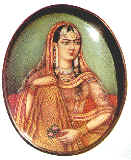
All that was Persian in Mongol Miniature seems to steady, but surely disappear. The style predominant at Jehangir's time was continued and slowly perfected during the reign of Shah Jehan. The most popular themes in both these reigns seem to be Royal Court in all its glory, and portraits of courtiers, often in groups.
A "new" technique was also developed at about this time, that of lightly touching sketch with gold or any color, but even this so-called "new" technique owed a lot to similar developments in Persian Art. Paintings, however good they may be technically, sadly lack the essential vitality found in those of Akbar's period.
Although most scholars feel that Mongol Art passed its zenith after the reign of Shah Jehan, which came to end in 1658, yet it remained technically sound until the last years of Emperor Mohammad Shah, who died in 1748.
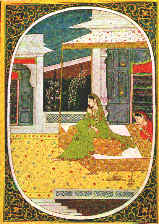
The gradual decline of the once glorious Mongol Empire saw the artistic moving away from Imperial Capital. It was an age when patronage was declining at Mongol Delhi and political upheavals were decimating princely courts; wandering artists found sanctuary and new patrons in the hill principalities. There, they developed new idioms, which blended the intricate and rather sophisticated Mongol style with more vigorous and energetic folk art of the hill people - this school known as "Pahari" (means 'hill'), generated a brief but exquisite renaissance of Indo-Pakistan miniature painting. Many fine examples of Pahari Art are to be found in Lahore Museum.
|
|