|
|
In the early centuries of Christian era, there flowered in North-western region of Pakistan, remarkable and unique Buddhist civilization in all its glory and splendor. It is now known the world over as "Gandhara Civilization". originally, however, the name stood for a country, ancient kingdom located in this part of Pakistan.
What exact areas its borders en compassed cannot be determined with any great accuracy today, but, according to Hsiang Tsang, the famed Chinese traveler, Empire of Gandhara "extends about 1000 li from East to West and about 800 li from North to South. It is bounded on East by Sin (Sindhu-Indus) river. Its capital is Po-lu-sha-pu-lo (Purushapura = Peshawar)".
This testimony, along with other available evidence, indicates that the kingdom of Gandhara was confined to the territories West of Indus, now comprising the valley of Peshawar and the hilly districts of Swat, Buner and Bajaur. But the art for which it is so famous extended far beyond its geographical borders.
Although separated by the waters of the mighty Indus and the lofty ranges of Himalayas and Hindukush, Gandhara remains have been discovered as far South as Mankiyala near Rawalpindi and as far North as Oxus river. This was evidently no isolated culture, but formed part of one and the same Buddhist civilization; its art was distinguished everywhere by the same general characteristic, with only minor local variations.
The geographical situation of this North-Western region, or what was once ancient Gandhara, placed it in strategic position to play significant role in history. It is fascinating country, rich with corps, well-watered by Indus and her branches and pleasant, with mils climate. Its majestic foot-hills have divided it into small, self contained valleys or Arcadian beauty, which bear striking resemblance to those of classical Greece.
Lying on borderland between Indo-Pakistan and Western Asia and belonging as little to the one as to the other, this country was admirably situated to evolve, along with the adjacent territories of Punjab and Afghanistan, unique art-form, which combined the best elements of classical East and West.
Politically, Gandhara was never under indigenous rule except once in its long and checkered history. It came successively under the domination of long line of foreign invaders. As a result, its people became cosmopolitan, not only in their culture and outlook, but also in their physical appearance.
Some of the figures, represented in Gandhara sculptures, are strikingly tall and dignified with baggy trousers and sleeved coat, closely resembling the present-day Pathans; others are characteristically Greek, Scythian or Parthian , while yet others possess the characteristics of Indo-Pakistani forms.
The common speech of the people was Prakrit, but the script was Kharoshthi, modified form of Aramaic, then current in Western Asia. The usual script for sacred texts was Brahmins. Evidently, Gandhara took its speech from Indo-Pakistan subcontinent and its writing from West. The intimate fusion of these two widely divergent elements is also traceable in many other aspects of contemporary life, but it is perhaps nowhere so clearly manifest as in sculptural art.
Gandhara was prosperous country, by all accounts. Her prosperity was assured as much by her fertile soil as by her peculiar geographical position. The great arterial trade routes, which traversed Asia, from China to Mediterranean coast and from Turkestan to Indo-Pakistan subcontinent, passed through this land, and it served as threshold between East and West.
Economic prosperity of Gandhara, and the importance of her key position in the world's commerce is attested to alike by literary and historical records and archaeological records. For two centuries, between 50 and 250 AD, Gandhara, or what is now North-West Pakistan, was kept busy with the transit trade of Orient, and it exacted a toll on all commodities that passed through its borders.
By Kushana times, this expanding trade and the increasing wealth it brought with it, made it necessary for Kanishka to adopt, for his gold coinage, themes from Western mythology and standard of weight from Roman currency. In arts and crafts, also, Gandhara was well-advanced and her products, which included delicately-worked gold and silver jewelry and carved ivory and metal objects, were highly prized in many parts of the civilized world.
The origin of Gandhara is lost in legendary obscurity. Though mentioned in Vedic literature, we find the first historical allusion to it in the Bisotoun Inscription of Darius I, dated 518 BC, which records Gandhara as conquered province. Since then, it remained under Persians as prosperous Satrapy, paying the largest tribute to Imperial coffers. Its particular geographical location, its flourishing trade and commerce, its arts and crafts, nurtured in unbroken peace, assured its continued prosperity.
The serene pool of life was, however, rudely distributed by Alexander, Macedonian intruder. His conquest of the province, in 326 BC, nevertheless proved a boon in disguise. Pagan Greeks soon found themselves subdued by superior religious logic of East and employed all their artistic skill and intelligence in its service, creating new Buddha with beautiful Roman features and oriental halo. This mode od sculpture marked a change from conventional Indian style.
Alexander's occupation was, however, short-lived and apparently inconsequential. Not so, Mauryan period followed it. This was significant and decisive period in the history of Gandhara. For, it was Asoka, Mauryan Emperor, and his missionaries, who converted the country to Buddhism. His rock-edicts at Shahbazgarhi and Mansehra bear eloquent testimony of his missionary zeal. He is credited with the building of 84,000 religious edifices in different parts of this country, some of which are still traceable.
Asoka's death in 232 BC was followed by period of gradual decline. Situated as it was, on turbulent border along the direct line of invasions, Gandhara remained in state of perpetual unrest for more than three centuries, during which it was successively invaded and conquered by Bactrian Greeks, Scythians, Parthian and Kushans. Under Kanishka, the great Kushan Emperor, country once again enjoyed peace and prosperity and its arts and crafts flourished as they never had before. The liberal patronage of Kanishka, vast resources of his far-flung empire, its strength and validity, and its trade and commerce now provided suitable environment for the full flowering of composite Buddhist art of Gandhara.
But, foreign invasions were not yet over. In 3rd century of our era, Gandhara was again conquered by Sassanid dynasty of Persia (Iran), followed by Kidara Kushans.
Of the final fate of this fascinating Buddhist civilization, archaeology combines with history to give us broad idea. Shortly after the middle of 5th century AD, sung Yun, Chinese pilgrim, while passing through this country, recorded: "This this the country which Ye Tha destroyed." Gandhara never recovered from the violent destruction by Ye Tha, or White Huns.
Despite all these vicissitudes, Gandhara had become a great center of Buddhism. Buddha himself, however, never came to this country, nor was his religion ever preached here before Asoka's time, some 200 years the death of the Master. And it was until the advent of Kushans that this region assumed importance in the history of Buddhism. Huge monasteries and universities began to spring up and, although not associated with Buddha's mortal career, Gandhara gained special renown for sanctity through the association of many of its sites with Jataka stories. Large number of pilgrim route to holy spots, which dot the country, often marked by colossal rock-carved Buddha's, attest to the veneration in which this land was once held by Buddhists. Indeed, this place was held in such high esteem in Buddhist world that some of Chinese pilgrims did not feel the necessity of visiting any other part of Subcontinent.
Kanishka turned Gandhara into veritable holy land of Buddhism. He converted Fourth Buddhist Council and it is generally believed that Maahayana Buddhism made its first appearance under his patronage and guidance.
Of the vast remains of Gandhara, monasteries and city-sites of Taxila, Takht-Bahi and Swat take priority, due largely to the extend of their scientific investigation and their state of preservation in recent times. In ancient times, their fame was rivaled and sometimes outstripped by many others, particularly in and around the vale of Peshawar. An idea of the wealth and affluence of some of these religious establishments can be gained from the fact that Sung Yun recorded the presence of 6000 gold images in the single monastery of "Talo", now identified with the stupa of Butkara in Swat.
The sculptural art, which gradually developed here, was primarily religious art, mirror of its moral and spiritual life. No study of this art is possible without reference to religion, which it served and the man who preached it. But Buddhism, which so vitally influenced life and imagination in Gandhara, was originally philosophy of life rather than religion. Buddha advocated middle path between indulgence and asceticism and sought ultimate deliverance from accumulated sin in supreme detachment, Nirvana.
Buddha, himself, was mortal, essentially and tangibly human. But after his death, as time passed, the person of Master gradually became obscure in the din light of dogmatic speculation, which turned him into legendary figure, with myths woven around him. Itis this Mahayana Buddha and his associates, whom the Gandhara artists attempted to portray.
In Hinayana or the earlier form of Buddhism, Buddha himself was never portrayed in his earthly form, his presence being symbolized instead by empty seat, foot-print, umbrella or rider-less horse. In Mahayana Buddhism, which replaces the earlier form, the figure of Master occupies central position, commanding and controlling the entire composition of panel. The invention of this Buddha is the greatest contribution of Gandhara art and Asia's greatest artistic achievement.
This was revolutionary change, both ichnographically and aesthetically, which found its first and full artistic expression in Gandhara. But to express this new observance, there was neither any comprehensive traditional idiom in the country, nor was the appearance of the Master remembered by his followers. How then determine the figure and features of Buddha and how to express this new idea? Obviously new conception was needed and close parallels were available in iconography and art-form of Imperial Rome. It was thus natural for the Gandhara artists to turn to classical West for inspiration and to give its art idiom Buddhist context. Thus Hellenism in its eastward course and Buddhisn in its westward march came in direct contact in Gandhara and worked out artistic synthesis.
For this fusion, the ground was already prepared by the long and intimate contact of Gandhara with West, further strengthened by migration of artists and craftsmen and import of art objects from Roman Empire during the prosperous reign of Kanishka. This blending of eastern with Western elements to create essentially oriental style, Roman in form and Buddhist in motif, is the most distinctive quality of this Buddhist art of Pakistan. In subject matter, it retained to the last its dominant religious bias.
Thus by combining the features of East and West, head of Apollo and body of toga-clad Roman Senator with half-shut eyes and crossed leg posture of oriental sage, Gandhara artist achieved remarkable success. And once created, this Buddha statue was accepted and copied in every country, where homage was paid to the Master. Gandhara art enjoyed exceptionally long life. Then followed long productive period, succeeded by slow decline, as evidenced by loss of technical skill, monotonous repetition and weakness of composition.
The scope of this art was not limited exclusively to religious subjects; it covered, incidentally, many other aspects of life. We have, in fact, panoramic view of the people at work and play and engaged in various other activities. Lovers, dancers, musicians, travelers, ascetics, wrestlers, and even robbers, too, have not been left out. Costumes of people, weapons of war and chase, musical instruments, toilet articles, jewelry, tools, carts and carriages all are represented in varying degrees. The comical side of life is represented by remarkable group of dwarfs, Atlantes, while popular imagination and beliefs are represented by equally remarkable groups of Yakshis, the darling of the people.
Among the subjects, introduced from classical themes, are the sphinx, griffon, centaur, triton, hippo camp, atlantid, erote, and number of other architectural features; but these were employed in decorative rather than devotional way.
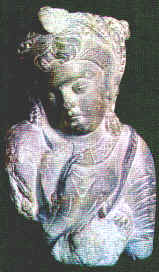
Gandhara art has survived now mainly in sculpture form, partly in schist stone and partly in stucco and, in rare cases, also in clay.
|
|