|
|
On the whole, formal elements in Indian art represent purely mental attitudes. This makes it largely introspective. The idea, as in Yoga, is to do away with all distracting influences and fugitive emotions. This makes environment in Indian art secondary. The main concern of Indian iconography, even when it adopts certain features in ornaments, costumes, etc. from contemporary life, is religious and metaphysical.
The question of environment in Indian art needs to be viewed on the context of the idea of Sadrishya in Hindu aesthetic, which does not imply naturalism, verisimilitude, illustration or illusion in any superficial sense. What really matters is Pramana, "creation of truth", which means "ideal proportion".
According to Hindu aesthetics, particularly during medieval period, art is essentially conventional, for it is only by convention that nature can be made intelligible, and only by signs and symbols that communication is made possible. That is why symbols play such a crucial role in Indian art.
Convention in this view has no derogatory implication as in the case of decadent art. It boils down to set of formulae evolved to express the true meaning of the objects that artists paint or sculpt.
Methods of responding space in art will always respond more or less to contemporary habits of vision, and this is all that is required for art. Perspective is nothing, but the means, employed to convey to the spectator, the idea of 3-dimensional space, and among the different kinds of perspective, which art has made use of in different ages, the one claiming to be "scientific" has no particular advantage from the aesthetic point of view. Very often Indian artists make representation of nature in their work purely symbolical.
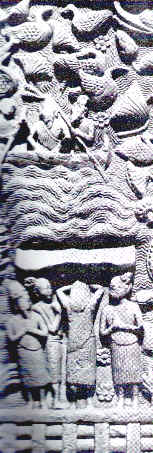
In early Indian art, roughly from 2nd century BC to 3rd century AD, there is certain emphasis on social environment. Artists, as in Amaravati and Barhut, try to object contemporary life and seek not only to render episodes from Buddha's life through symbols, but also to represent the worship of Yaksha, Naga, and trees so prevalent among the common people during this period.
But this is not an entirely demotic art devoted to the representation of various aspects to popular life. Artists are always at pains to emphasize that the outward features of nature make only limited sense. Nature as they depict it is of deep symbolical significance. There is some evidence of water cosmology in their work, which cannot be understood without the help of early Indian literature.
The view, also, informs Indian painting until 6th century AD, as is evident in the wall paintings of Ajanta and Bagh.
With the beginning of Gupta period new element makes it appearance. Artists are no longer concerned with people, but with gods and their habitat. But even with this shift in emphasis, they do react to environment, though to much limited degree. Representation of nature becomes much more stereotyped. Vishnudharmottara Purana, written during this period, devotes a section to painting and it explains how the conventions are to be observed.
In the following centuries, as seen in the paintings at Sittanavasal, Ellora and Tanjore, the world of the gods comes fully into its own and there is little trace of contemporary life.
Indian painting after 10th century, as in the palm leaf Buddhist manuscripts, also leaves contemporary life, as well as nature severely alone. Ignoring their surroundings, painters concentrate solely on Buddhist gods and goddesses and Mandalas... Since they have only restricted space at their disposal, they are content to paint images of gods and goddesses. This imbues the manuscripts they illustrate with magical power making them object of worship by devotees. The only environment these painters care for is that of Tantric Buddhist beliefs. They are not bothered in the least either about nature or social conditions of the period.
The illustrated palm leaf manuscripts, produced by Jains in 13th century and later, also concern themselves entirely with gods, goddesses and Yakshas and Vidhyadevis, to start with. But with the introduction of paper, painters in Western India find a little more space for their compositions and soon begin painting episodes from the lives of Jaina Tirthankaras as narrated in Kalpasutra.
Even though their attention is focused on the story, Jain artists of his period are more aware of their environment than Buddhist painters. They try to render contemporary architecture, though in very much simplified form and contemporary costumes as well. Their treatment of landscape is generally ornamental. Their primary purpose, however, is to do justice to the stories. They have no use for any innovation, which is outside the scope of their art.
By the end of 14th century, Jain painters become a little more alive to their social environment. In the manuscripts of Kalakachharya Katha, they use Muslim stereotype to represent all foreigners, who figure in the stories. This shows that they have precise idea by now of Turks, who ruled over Northern and Western India during this period. Their work is based on personal observation and also on Iranian figures, appearing in contemporary illustrated Persian manuscripts. In the more elaborate manuscripts of Kalakachharya Katha of this period, painters even borrow and introduce persian elements in their border decorations, which sometimes depict scenes from the daily life of common people, both Muslim and Hindu.
Landscapes in these manuscripts are painted as separate compositions without forming background to any particular scene. Decorative designs are often borrowed from contemporary architecture. Manuscripts reveal the life of the people and court far more vividly than any literary source of the period.
There is still keener awareness of the environment in some of the manuscripts, painted in the first half of 16th century. Digambara Jain painters of the period depict many aspects of contemporary life hitherto untouched by artists. It is for the first time, for instance, that they illustrate certain features of rural life, tillers of the soil and herdsmen at work and women engaged in daily domestic cores.
They, also, render various aspects of life in cities - palace scenes, marriage festivities...- not seen in previous manuscripts. Nature, too, gets more attention than before and there are full-page illustrations depicting forests as well as wild animals.
This period also sees the production of some illustrated manuscripts, which overcome the limitation of the folk phase. Manuscripts of Niamat Namha (1500-1510 AD), painted in Malwa, and of Laur Chanda (1500-1525 AD), painted in U.P., prepare the ground for Mongol painting. Artists are fully aware of their surroundings by now. One new feature of this phase of Indian art is closer association of painting with literature. Painters illustrate Avadhi romances for the first time, giving glimpses of the daily life of the people. They depict water a little more realistically than before.
Under Akbar, painting receives new impetus. New painters, even as they imbibe certain features from the older Indian tradition, are under the sway of Persian art and are influenced, to a limit extent, even by European art. Religious themes, now, become of secondary interest. Nature is no longer symbolical, but provides proper background to the composition. Painters still observe certain conventions in the treatment of mountains and trees, but make conscious effort to portray nature more realistically than before. Their work also giver better idea of daily life of the court and people. Even those who illustrate Hindu epics, Ramayana and Mahabharata, during the period make their compositions as realistic as possible. Architecture becomes important element in painting during this period.
By the time of Jehangir, painters depict variety of people at work - bookbinders, jewelers, etc - with new verve. They are fully alive to their environment and their work contributes most interesting record of the life of the period. They carry the art of portraiture to new stage of refinement and sophistication.
Another interesting feature of Mongol painting is faithful representation of birds and animals. Painters no longer treat them as decorative motifs, but as living creatures.
Art of painting, which flourishes in many centers of Rajasthan, Malwa and Bundelkhand during this period, and later on in Kangra hills, is far more faithful to the old tradition, but it also comes under the sway of Mongol painting. Thus, nature in Rasjasthan painting is treated far more elaborately than in any previous Indian art. But the treatment is not faithful to appearance; it rather follows contemporary Hindi poetry. The aim of the artist is to create appropriate atmosphere for the intense drama of love and romance.
As for themes, Rajasthan painting, at least in the beginning, is entirely devoted to representations of the episodes from Krishna legends and Puranic and folk stories. Architecture in Rajasthan painting received very little attention, except in Kangra paintings. But in depicting the frolics of Krishna, painters draw contemporary sports, picnic and dances.
Rajasthan art is not strictly religious as understood. It, no doubt, deals with religious themes to meet the demands of common people. It real forte lies in its use of brilliant enamel-like colors.
The late Kangra paintings are informed with gentler view of life. Landscape is more dense and lush than before, romance is more colorful and the emotion of love more vibrating than before. No one can appreciate this brilliant phase of Indian painting without understanding of Brajbhasha poetry, which inspires it. But, while Kangra painters are alive to their natural surroundings, they are indifferent to the political turmoil around them.
|
|